
TL;DR

Get furniture and decor delivered free with Prime
- Fast, free delivery on millions of items
- Prime Video, Amazon Music and more included
- Member-only deals all year
A Hunker report describes a DIY project from the YouTube channel Your Home, Renewed, which uses automotive pinstriping tape on both sides of a window to imitate leaded glass. The creators said their materials cost about $40, compared with a few hundred dollars for decorative window film; the effect is decorative, not a replacement for actual leaded glass or a window repair.
A DIY project featured by Hunker shows how automotive striping tape can create a leaded-glass-inspired window pattern for about $40, according to the report. The design, developed by creators at Your Home, Renewed, offers a lower-cost decorative option for people who want to leave windows uncovered, though it does not repair damaged glazing or replicate the construction of genuine leaded glass.
The creators developed the idea after noticing that the seal between the panes of their bay window was failing. They wanted to disguise the appearance while saving for a replacement window. Hunker reports that decorative window film they considered would have cost a few hundred dollars, while their tape-based approach cost about $40.
The method starts with planning a grid or other pattern on the glass. The DIYers used masking tape to test the spacing; a ruler and dry-erase marker can also be used to map out lines and adjust the design before applying the permanent-looking strips. Automotive pinstriping tape is available in different widths, and some versions have a metallic finish, according to the report.
To suggest the appearance of lead cames—the strips that hold sections of glass together in traditional leaded windows—the tape is applied to both sides of the glass. Hunker advises cutting intersecting strips so their ends meet flush rather than overlapping. It also warns against stretching the tape during application, since tension may contribute to the strips peeling away. The report says the tape can be removed by loosening a corner with a plastic scraper and peeling it back at an angle.
A Lower-Cost Way to Dress Bare Windows
The idea gives homeowners and renters a way to add a decorative grid without paying for custom leaded glass or installing curtains. The reported $40 materials cost is substantially below the few-hundred-dollar price the creators encountered for window film, although the figures are specific to their project and are not a general price estimate for every window.
Its reversibility may appeal to renters or people who want to test a design before committing to a permanent change. At the same time, the tape is a visual treatment only: it does not fix a failed window seal, improve insulation, or provide the durability of built-in leaded glass. Anyone using it to disguise a window problem would still need to address the underlying issue separately.
Products Worth Considering

Philips Hue Bridge Pro Smart Lighting Hub

Shark Rotator Lift-Away Vacuum with DuoClean PowerFins (LA555) – Dark Grey

Ring Alarm 8-Piece Kit (2nd Gen) Home Security System
As an affiliate, we earn on qualifying purchases.
From a Failing Bay Window to a DIY Grid
The project began as a temporary response to a bay window whose seal between panes was failing, according to Hunker. Rather than immediately purchasing a replacement window, the creators sought a way to make the visible problem less prominent while they saved for that work. Their initial comparison was with decorative window film, which they said would cost a few hundred dollars.
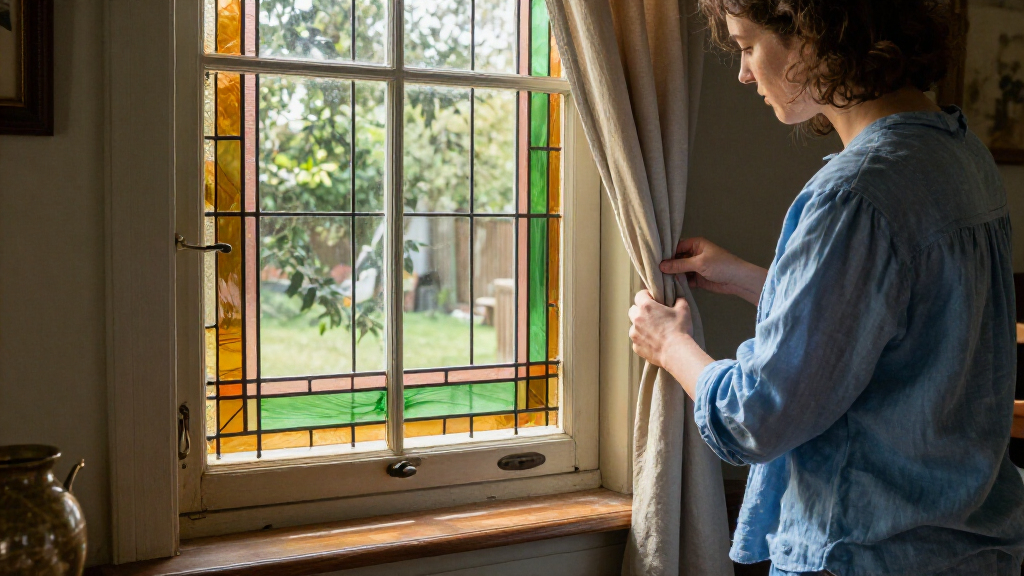
Traditional leaded glass uses lead strips, known as cames, to join separate pieces of glass. The tape project imitates the lines of that construction on the surface of an existing pane; it does not use lead or divide the glass into separate pieces. The distinction matters because the finished look is decorative and surface-applied, not a structural or historical restoration.
“The DIYers mapped out the grid with masking tape first to test out spacing.”
— Hunker, describing the project by Your Home, Renewed
Durability and Costs Will Vary
The supplied report does not give the window dimensions, tape quantity, brand used by the creators, or a detailed cost breakdown behind the about $40 figure. It also does not say how long the tape remained in place or how it performed under different conditions, such as direct sunlight, moisture, or repeated cleaning. The project’s cost and durability may depend on the window and materials.
It is also unclear whether the tape would be suitable for every glass surface or leave residue after removal. The source describes the creators’ experience but does not provide independent testing or a guarantee that the tape will come off cleanly in all cases. The design may camouflage a visible flaw, but it cannot establish whether a failing seal needs repair or replacement.
Plan the Pattern Before Applying Tape
Anyone considering the approach can first measure the glass and sketch a pattern, then use masking tape or a dry-erase marker to check spacing before committing. The report recommends using a ruler for straight lines, choosing tape width to suit the design, applying strips without stretching them, and cutting intersections to meet neatly. Applying the pattern to both sides of the glass is part of the method described by the creators.
For a window with a suspected seal failure, the decorative treatment should not replace an assessment of the window’s condition. The next practical step is to determine whether repair or replacement is needed and treat the tape as a separate cosmetic choice. Hunker’s report does not announce a product launch or a formal follow-up; it presents the project as a low-cost DIY option rather than a new window solution.
Key Questions
What does the DIY use to imitate leaded glass?
It uses automotive striping tape arranged in a grid or another pattern on both sides of the window glass.
How much did the creators say their project cost?
Hunker reports that the creators spent about $40. The report does not provide a full materials list or say whether the same cost would apply to windows of different sizes.
Can the tape be removed?
The report says to loosen a strip’s corner with a plastic scraper and peel it back at an angle. It does not guarantee residue-free removal on every type of glass or finish.
Does the tape fix a failing window seal?
No. The design is a surface decoration intended to disguise the appearance of a problem. It does not repair a seal or replace professional assessment of a damaged window.
Source: hunker.com