
TL;DR

Get furniture and decor delivered free with Prime
- Fast, free delivery on millions of items
- Prime Video, Amazon Music and more included
- Member-only deals all year
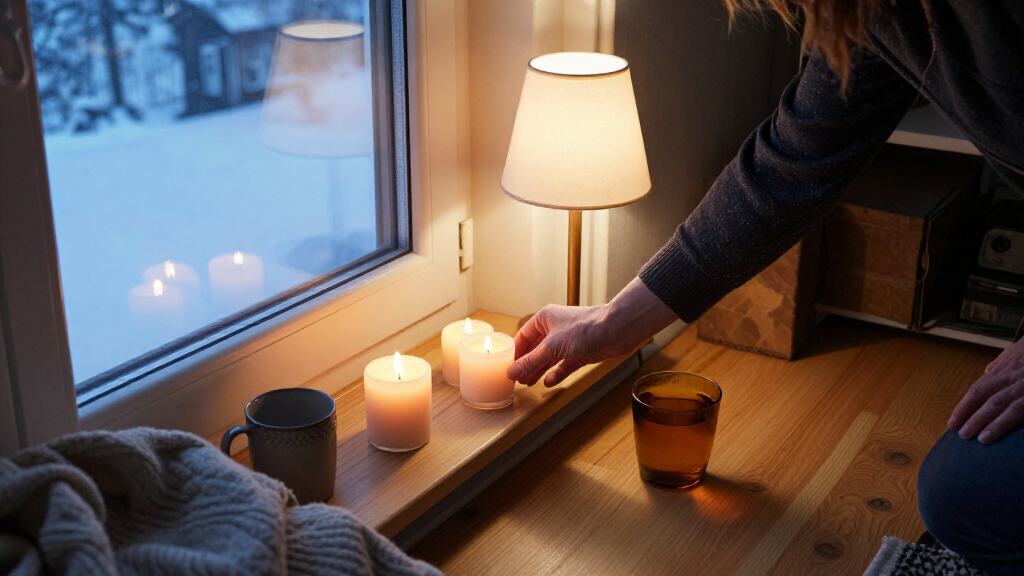
A Livingetc report shares Norwegian designer Gudbjørg Simonsen’s approach to lighting homes during short winter days. Her advice emphasizes varied illumination, layered light and atmosphere rather than making every corner equally bright.
Norwegian designer Gudbjørg Simonsen advises treating winter darkness as part of a home’s design rather than trying to eliminate it, according to a Livingetc report. Her recommendations include using varied pools of light and combining practical fixtures with softer, decorative lighting—an approach shaped by the large seasonal changes in daylight across Norway.
Simonsen, who is based in Stavanger, says a lighting plan should account for how daylight changes across the year. In the report, she argues that rooms should not be designed as though light remains constant from season to season. Materials, color, shadow and artificial light can all feel different as the available daylight shifts.
One recommendation is to avoid lighting every part of a room evenly. Simonsen says she prefers variation, with brighter areas, softer transitions and some shadow. She compares this to natural light, which is rarely uniform. The report suggests that deliberately varied lighting can give a room more depth than a single, even wash of brightness.
She also describes lighting as both practical and emotional. Task lighting can illuminate a work surface or help people move through a room, while other light can create intimacy and a welcoming atmosphere. Simonsen favors discreet or integrated fittings for some practical needs, so the effect of the light can take precedence over the fixture itself.
Lighting for Short Winter Days
The advice addresses a practical challenge for people living with limited winter daylight: how to make indoor spaces usable while also making them feel comfortable. Simonsen’s approach treats those aims as related but distinct. A light that helps someone read, cook or work does not necessarily create the softer atmosphere they want in the evening.
Her emphasis on several types of lighting offers a way to tailor a room to different activities and times of day. It also challenges the assumption that every shadow should be removed. For readers considering changes at home, the report points toward adjusting the placement and character of light, rather than relying only on making a room brighter.
As an affiliate, we earn on qualifying purchases.
Norway’s Changing Daylight
The Livingetc report says Norway can receive up to six hours of daylight per day in December, while its northernmost areas can have no daylight during parts of winter. The amount of daylight varies by location, so the report’s figures should not be read as applying to every Norwegian home.
Simonsen’s design approach also considers the surrounding environment and the people who live in each home. She says she draws on traditional Norwegian architecture and the changing seasons, rather than treating lighting as a technical issue alone. The article presents her comments as design advice, not as a study of lighting’s health effects or a measured comparison of particular fixtures.
“I don’t think we can design homes as though light remains constant throughout the year. Nor do I think the answer is to fight the darkness.”
— Gudbjørg Simonsen, Norwegian designer, as quoted by Livingetc
As an affiliate, we earn on qualifying purchases.
Limits of the Lighting Advice
The supplied Livingetc material gives design guidance and personal observations, but does not report controlled research showing how particular lighting choices affect mood, sleep or health. It also does not specify fixture models, brightness levels, color temperatures or a complete room-by-room plan. The daylight figures are broad descriptions; local conditions differ across Norway, and the article does not provide a detailed geographic breakdown.
As an affiliate, we earn on qualifying purchases.
Applying the Ideas at Home
The report does not announce a product launch, formal program or later milestone. Its practical next step for readers is to consider what each area of a room needs: focused light for tasks, discreet lighting for movement and softer sources for atmosphere. Simonsen’s guidance also suggests observing how daylight shifts through a space and deciding where contrast or shadow is welcome, rather than automatically aiming for uniform brightness.
Any specific choices will depend on the room, its use and the available natural light. The source does not provide technical installation instructions or claim that one lighting scheme suits every household.
adjustable wall sconces for living room
As an affiliate, we earn on qualifying purchases.
As an affiliate, we earn on qualifying purchases.
Key Questions
What is Simonsen’s main advice for winter lighting?
She recommends designing with seasonal darkness, using varied and layered light rather than trying to illuminate every part of a room evenly.
What does layered lighting mean in this report?
It means using different kinds of light for different purposes, such as task lighting for work and softer lighting to shape the room’s atmosphere.
How much daylight does Norway get in December?
Livingetc says Norway can receive up to six hours of daylight per day in December, while the country’s northernmost areas can have periods with no daylight. Conditions vary by location.
Does the report say darkness should be eliminated?
No. Simonsen says she does not think the answer is to fight darkness. She recommends working with light, shadow and seasonal change as parts of a home’s atmosphere.
Source: rss
Fall Picks
fall essentials
As an affiliate, we earn on qualifying purchases.