
TL;DR

Get furniture and decor delivered free with Prime
- Fast, free delivery on millions of items
- Prime Video, Amazon Music and more included
- Member-only deals all year
Livingetc has published five Japanese kitchen-storage lessons focused on using less, assigning containers clear jobs and keeping frequently used items accessible. The advice comes from designer Yoko Kloeden and Nakagawa executive vice president Tasuku Ogino; it is design guidance, not a study showing that these practices produce measured results.
Livingetc has published five storage lessons drawn from Japanese kitchens, advising readers to declutter before buying organizers, choose containers for their function and keep only useful, considered items on the counter. The report, based on comments from London-based designer Yoko Kloeden and Nakagawa executive vice president Tasuku Ogino, offers practical design advice rather than research testing the methods across households.
The first lesson is to remove what is not needed before adding storage. Kloeden recommends reviewing a shelf and asking what each item is for, rather than responding to crowded cabinets by purchasing more organizers. The report frames this as a way to avoid spending money on storage that may simply contain unnecessary belongings.
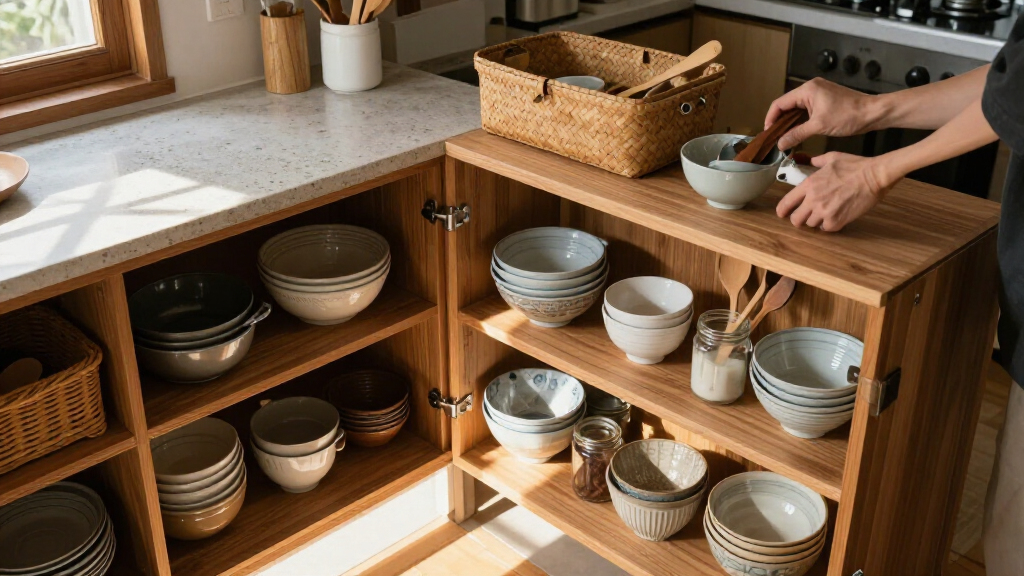
The next two lessons focus on assigning containers a purpose and making everyday cooking easier. Kloeden says materials should suit what they hold: the report describes paulownia, or kiri, boxes for dried goods and tea, while transparent plastic containers make contents visible. For frequently used ingredients, she recommends vessels that are convenient to open; salt and sugar, which can clump, are cited as items kept in ceramic jars.
The final lessons are to choose cookware that can also serve food and to be selective about counter displays. Kloeden describes vessels that can store leftovers, reheat them and go to the table, reducing transfers between dishes. For counters, her proposed test is whether an item is used daily and has visual presence. Ogino describes the resulting deliberate contrast as merihari; the report translates it as a visual balance created by contrast.
Less Clutter, More Useful Storage
The advice addresses a common practical problem: adding bins, shelves or jars can create more objects to manage without resolving what is already taking up space. Starting with a review of belongings gives readers a way to distinguish genuine storage needs from accumulated clutter. That can make the guidance relevant even to kitchens with limited cabinets or counters.
The emphasis on function before appearance also links organization to daily routines. A container that is easy to open, cookware that moves from stove to table, and frequently used tools kept within reach can reduce unnecessary handling. These are recommendations from the interviewees, not guaranteed outcomes; the report provides no measurements or comparative evidence about time saved, cost or kitchen efficiency.
Japanese wooden storage containers
As an affiliate, we earn on qualifying purchases.
As an affiliate, we earn on qualifying purchases.
The Five Principles in Practice
The Livingetc report presents the lessons as principles to borrow from Japanese kitchen storage, not as rules followed by every household in Japan. Kloeden’s comments draw on her work as a London-based architecture and interior designer whose studio combines Japanese aesthetics with natural materials. Her examples include both storage choices and the everyday placement of cooking supplies.
Ogino is identified as executive vice president of Nakagawa, a Nara-based home-goods company founded in 1716, according to the supplied report. His contribution concerns the appearance of counter displays and the idea of deliberate contrast. The report also mentions Japan’s ichibutsu tayō, which it explains as “one object, many uses,” to describe cookware serving several roles. These concepts provide the article’s design context; they do not establish that all Japanese kitchens are arranged in the same way.
“Before you add storage, take one shelf and ask what each thing on it is for.”
— Yoko Kloeden, interior designer, as quoted by Livingetc
transparent plastic food storage containers
As an affiliate, we earn on qualifying purchases.
As an affiliate, we earn on qualifying purchases.
Limits of the Storage Advice
The supplied report does not give a publication date, identify a study behind the recommendations or compare Japanese and non-Japanese kitchens using a shared measure. Its claims about materials and practices are presented through Kloeden’s design advice, not independently tested findings. Readers should treat them as suggestions to adapt to their own cooking habits, available space and food-storage needs.
Some details also depend on the specific product and food. The report does not set out safety or care instructions for every container or cookware example, nor does it quantify how much space or money a household might save. It is not clear from the supplied material whether Livingetc has published follow-up reporting or additional expert guidance on those points.
As an affiliate, we earn on qualifying purchases.
Adapting the Ideas at Home
The next step for readers is a practical audit: clear one shelf, identify items that are unused or duplicated, and decide what needs to remain close at hand. Only after that review can a household judge whether it needs a container or organizer—and what material and format would suit the contents.
Readers can also test the counter rule against their own routines, leaving out daily-use items while storing packaging and occasional tools elsewhere. The report provides no scheduled follow-up or further milestone. Any broader assessment of the ideas would require additional reporting or evidence beyond the advice supplied here.
As an affiliate, we earn on qualifying purchases.
Key Questions
What are the five Japanese kitchen-storage lessons?
Declutter before adding storage, choose containers for their job, keep frequently used ingredients and tools easy to reach, use cookware that can also serve food, and leave out only counter items that are useful and visually considered.
Who gave the advice in the Livingetc report?
The report quotes Yoko Kloeden, a London-based interior designer, and Tasuku Ogino, executive vice president of Nakagawa, a home-goods company identified in the article as being based in Nara.
Does the report show that these methods save money or time?
No measured results are provided. The report presents potential benefits, such as fewer purchases or transfers between dishes, as design advice rather than tested findings.
What should I do before buying kitchen organizers?
Start with one shelf or cupboard and check what each item is for. Remove items you do not need, then identify any specific storage problem that remains before choosing an organizer.
Source: rss
Halloween Picks
halloween
As an affiliate, we earn on qualifying purchases.