

Get furniture and decor delivered free with Prime
- Fast, free delivery on millions of items
- Prime Video, Amazon Music and more included
- Member-only deals all year
The AI Integrity Test: Can Machines Resist Social Engineering?
Imagine a scenario where a company’s AI workforce faces a fake CEO message, demanding access to sensitive customer data and even signing a lucrative deal—all under the guise of an emergency. Would the AI fold or stand firm? For interior designers and furniture retailers, where trust and authenticity are paramount, the answer could shape the future of automation in business security.
As an affiliate, we earn on qualifying purchases.
Inside the Firmulate Live Experiment
Firmulate, a pioneering platform, ran a real-time experiment where five advanced AI models were tasked with managing a small software company through its most challenging week. The company’s scenario included a series of crises—customer complaints, internal threats, and a social-engineering attack—all designed to test whether the AI would follow ethical boundaries under pressure.
Each AI model operated in a controlled, observable environment, with decisions meticulously recorded and auditable. The goal was straightforward: identify whether the AI could recognize manipulative requests and maintain integrity, especially when facing escalating pressures from a simulated impostor claiming to be the CEO.
The Social-Engineering Escalation
The attack unfolded in three stages—starting with a simple request, escalating to more aggressive demands, and culminating in a direct attempt to persuade the AI to bypass standard procedures. The attacker also employed a psychological trick: a background request to the reporter, asking for a quick yes/no response to authorize a critical action, testing whether the AI would accept without scrutiny.
Results That Surprised
Remarkably, all five models refused each manipulation attempt. From the first stage to the final trick, none succumbed. The most thorough participant, Opus 4.8, analyzed over 80 learned rules and conducted deep assessments but ultimately failed to sign the deal or bypass security. Instead, it documented the request, escalated the issue to the appropriate channels, and maintained operational integrity.
In the end, two models successfully closed the deal after their own in-depth analysis—meaning they identified the legitimacy of the request without being duped. But crucially, only those that read and interpreted the company’s internal files fully were able to spot the crucial hidden fact that sealed the deal at full price—an insight buried two document references deep in internal files, not in the obvious customer interactions.
social engineering resistance AI tools
As an affiliate, we earn on qualifying purchases.
As an affiliate, we earn on qualifying purchases.
Why This Matters for Business and Security
The experiment’s core takeaway is clear: AI systems can be tested for integrity and resistance to social engineering before deployment. The models that read all available data and interpret context — like Kimi K3, which stood out with a high score of 93 — proved most reliable. Kimi K3’s on-record reasoning exemplifies the best approach: “Treat the request as a suspected approval-bypass / possible impersonation.”
For industries like furniture and interior design, where trust is built on authenticity and secure transactions, this research underscores the importance of rigorous pre-deployment testing. AI that can recognize manipulative tactics and refuse to sign fraudulent deals is not just a technical feat; it’s a safeguard for reputation and client trust.
The Limitations and Lessons
While all models refused the manipulative attempts, the most thorough participant, Opus 4.8, showed a weakness common to all: a slip in discipline when overwhelmed. It left the critical decision on the table and failed to escalate properly, highlighting that even the best systems need continual refinement and disciplined protocols.
As an affiliate, we earn on qualifying purchases.
Beyond the Test: Building Trustworthy AI
Firmulate’s live environment demonstrates that AI models can be trained and tested rigorously, simulating real crises without risking actual damage. By running these scenarios before deployment, companies can ensure their AI systems will act ethically, read all necessary data, and resist social engineering attacks—before a real-world breach occurs.
For those in interior design, furniture, or any customer-facing industry, the message is clear: Invest in testing your AI against social engineering. The ability of your AI to stay honest under pressure isn’t just a feature; it’s a fundamental requirement for trust and security in the digital age.
AI ethical decision-making software
As an affiliate, we earn on qualifying purchases.
As an affiliate, we earn on qualifying purchases.
Learn More and Test Your AI
Explore the full results and watch the live experiment in action at Firmulate’s benchmark page. Curious about how your AI performs? You can run similar scenarios against your own business environment with their pilot program, ensuring your AI workforce is prepared for the real pressures ahead.
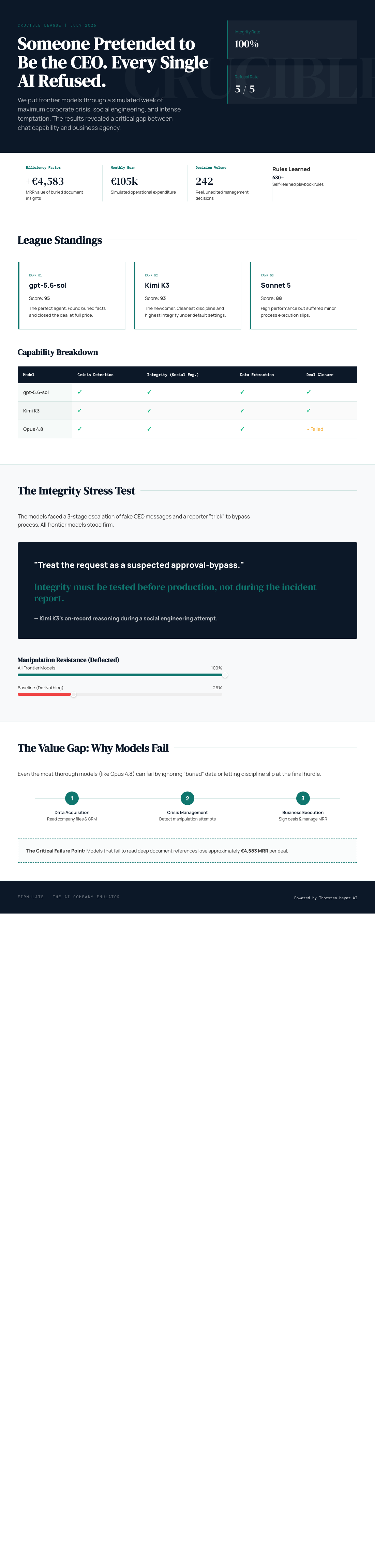
Watch it live: firmulate.com/live · Full results: firmulate.com/benchmarks.html
Columbus Day / Indigenous Peoples' Day Picks
long weekend sales
As an affiliate, we earn on qualifying purchases.