
Music-first subwoofers need different placement rules because their goal is to blend smoothly with your main speakers for natural, clear bass. Unlike home theater subs, they benefit from positioning away from walls or corners to avoid boomy or boomy or uneven sound. Proper placement, combined with acoustic calibration, helps you achieve balanced bass that supports detailed music enjoyment. Keep exploring to discover how strategic positioning enhances your listening experience and maximizes your subwoofer’s potential.

Get furniture and decor delivered free with Prime
- Fast, free delivery on millions of items
- Prime Video, Amazon Music and more included
- Member-only deals all year
Key Takeaways
- Music-first subwoofers prioritize tonal balance and clarity, requiring precise placement to avoid room-induced bass anomalies.
- They benefit from placement near seating or front of the room to ensure seamless sound integration.
- Unlike home theater subwoofers, they avoid corners and walls to prevent boomy or boomy, overly reinforced bass.
- Calibration tools help fine-tune placement, emphasizing room acoustics’ influence on sound quality.
- Strategic positioning enhances smooth bass response, supporting overall musical clarity rather than just loudness.
When it comes to achieving ideal sound quality with your music-first subwoofer, proper placement is essential. Unlike traditional subwoofers, which often prioritize deep bass extension and overall loudness, music-first models focus on clarity, detail, and seamless integration with your main speakers. To get the most out of your setup, you need to understand that placement rules differ because of the way music interacts with your room and the importance of Acoustic Calibration. Room acoustics play a significant role in how sound waves behave, bouncing off walls, furniture, and other surfaces, which can cause peaks and nulls in bass response. This means placing your subwoofer just anywhere won’t cut it; strategic positioning is key to achieving balanced, natural sound.
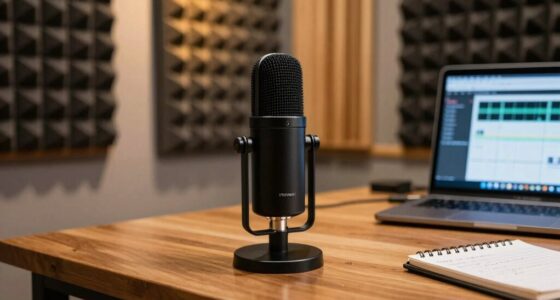
Proper placement begins with understanding how your room’s acoustics influence sound. For music, you want to avoid locations that cause destructive interference, where bass frequencies cancel out, or constructive interference, which can lead to boomy, exaggerated bass. In a music-first setup, your goal is to create a smooth bass response that supports the overall tonal balance. Acoustic Calibration tools, such as room correction software or dedicated calibration microphones, become invaluable here. They measure how sound interacts within your space and help you fine-tune your subwoofer’s position to compensate for room effects. This process ensures that the bass integrates seamlessly with your main speakers, delivering clarity and punch without muddiness. Additionally, understanding the impact of room acoustics on sound behavior is crucial for making informed placement decisions. Being aware of the room’s acoustic properties allows you to adapt your placement strategies to different environments and optimize sound quality. Incorporating room treatment techniques can also help improve sound quality by reducing unwanted reflections and resonances. Recognizing the different room configurations you might encounter allows for a more tailored approach to subwoofer placement.
Optimize sound by understanding room acoustics and using calibration tools for seamless subwoofer integration.
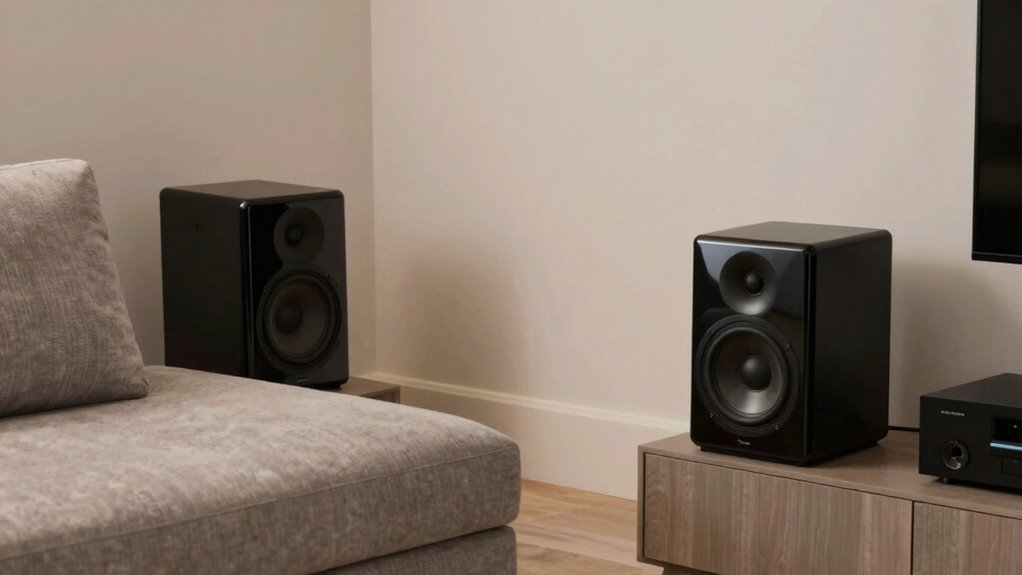
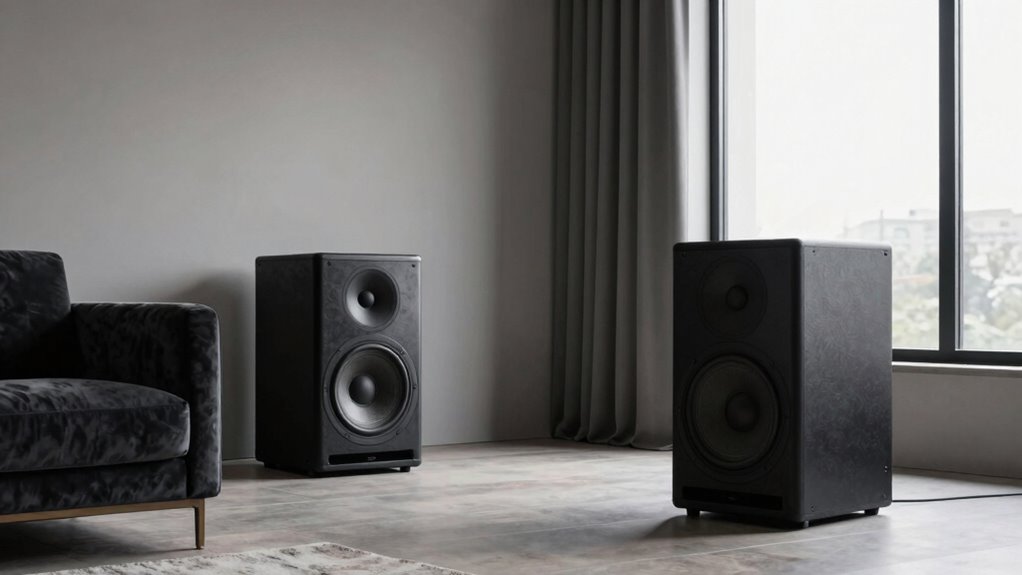
Unlike home theater subwoofers, which are often placed near walls or corners to maximize bass output, music-first subwoofers benefit from more nuanced placement. You might find success placing the subwoofer closer to the front of the room or near your seating area, where the sound can blend more naturally with your speakers. Experimentation is crucial—move the sub around and use Acoustic Calibration to assess the changes objectively. Small shifts can significantly improve sound quality by reducing room-induced anomalies. It’s also worth considering that different rooms have unique acoustics, so a placement that sounds good in one space might not work in another.
Ultimately, understanding that room acoustics influence how your music is perceived helps you make smarter placement decisions. Proper Acoustic Calibration ensures your subwoofer’s response complements your main speakers, resulting in a more accurate and enjoyable listening experience. Remember, the goal isn’t just loud bass but well-integrated, clear sound that enhances your music without overpowering it. By respecting these placement rules, you’ll unlock the true potential of your music-first subwoofer and transform your listening environment into a space where every note comes through with precision and depth.
music-first subwoofer placement tools
As an affiliate, we earn on qualifying purchases.
As an affiliate, we earn on qualifying purchases.
Frequently Asked Questions
How Do Room Acoustics Affect Music-First Subwoofer Placement?
Room acoustics markedly affect your music-first subwoofer placement. Room resonance can cause bass to sound boomy or uneven, so you need to find spots where resonance is minimized. Additionally, speaker isolation from walls or furniture helps prevent unwanted vibrations, ensuring clearer, more accurate sound. By adjusting placement to reduce resonance and improve isolation, you optimize your subwoofer’s performance and enjoy a more balanced, immersive listening experience.
Can Multiple Music-First Subwoofers Be Synchronized Effectively?
Yes, you can synchronize multiple music-first subwoofers effectively. Use wireless synchronization to connect them seamlessly, ensuring they operate in unison. Focus on phase alignment, adjusting each subwoofer’s settings to prevent sound cancellation or reinforcement issues. Properly synchronized subwoofers deliver a cohesive, powerful bass experience, filling your space evenly. Regularly check and fine-tune their settings to maintain peak performance and avoid phase issues that could compromise sound quality.
What Are the Signs of Improper Subwoofer Placement?
Improper subwoofer placement shows itself through uneven bass, rattling, or boomy sounds that don’t match your room’s acoustics. If your subwoofer’s size seems mismatched or you notice inconsistent sound, it might be poorly placed. Also, if the subwoofer’s power requirements aren’t met or it’s positioned too close to walls, you’ll experience distorted audio. Adjusting placement, considering size, and ensuring adequate power can fix these issues and improve your sound experience.
How Does Subwoofer Placement Impact Overall Sound Quality?
Your subwoofer placement directly impacts sound quality by affecting subwoofer frequency response and the accuracy of placement calibration. Proper positioning ensures smooth bass distribution and reduces muddiness or boomy sounds. If you place it too close to walls or corners, it can exaggerate bass, while poor placement can cause uneven sound. Adjusting your subwoofer’s location helps achieve balanced bass and ideal sound, creating a more immersive listening experience.
Are There Specific Furniture Considerations for Optimal Placement?
You should consider furniture interaction when placing your music-first subwoofer. Avoid positioning it too close to large pieces that might block sound or cause vibrations, and guarantee it doesn’t sit directly on soft surfaces that dampen bass. Aim for aesthetic integration by choosing a spot that blends seamlessly with your decor, like near a sturdy, open piece of furniture, which helps optimize sound quality while maintaining your room’s visual appeal.
room calibration microphone for subwoofers
As an affiliate, we earn on qualifying purchases.
As an affiliate, we earn on qualifying purchases.
Conclusion
By understanding that music-first subwoofers require different placement rules, you can unleash a sound experience that’s truly cosmic—like having your own personal concert hall in your living room. Don’t settle for subpar bass; instead, experiment with placement to achieve the perfect balance. Remember, a well-placed subwoofer isn’t just a piece of equipment—it’s the heartbeat of your music sanctuary. Get it right, and your sound will hit harder than a meteor crashing to Earth.
subwoofer acoustic calibration software
As an affiliate, we earn on qualifying purchases.
As an affiliate, we earn on qualifying purchases.
subwoofer position optimization for music
As an affiliate, we earn on qualifying purchases.
As an affiliate, we earn on qualifying purchases.
Halloween Picks
halloween
As an affiliate, we earn on qualifying purchases.