
TL;DR

Get furniture and decor delivered free with Prime
- Fast, free delivery on millions of items
- Prime Video, Amazon Music and more included
- Member-only deals all year
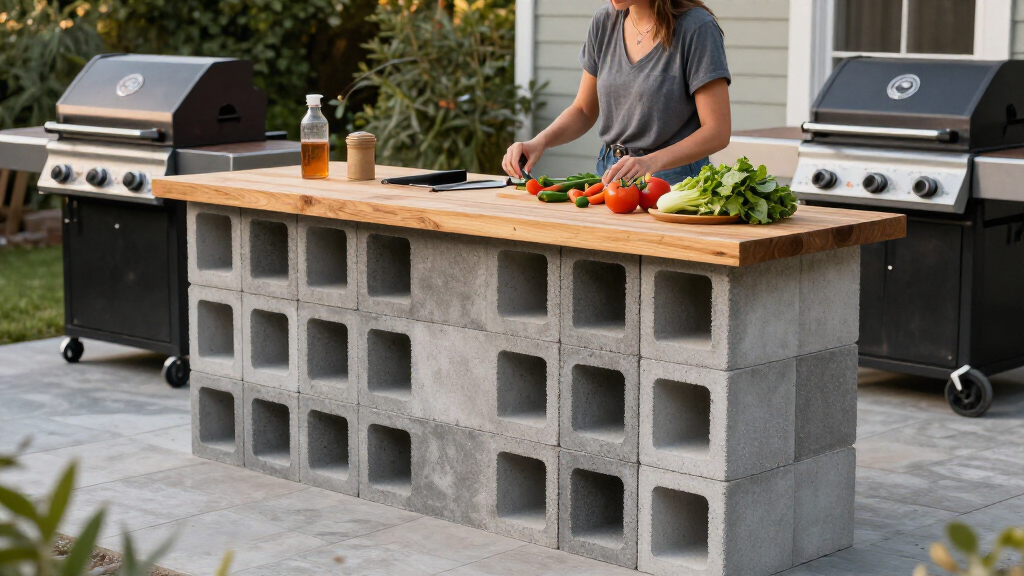
YouTuber Mr. Greg’s How To demonstrated a grill prep counter built from several sizes of concrete blocks, arranged in an L shape around a grill. The project uses dry-stacked blocks secured with surface bonding cement, but the source does not provide a full cost, construction measurements, or independent safety assessment.
A DIY video series from Mr. Greg’s How To demonstrates an outdoor grill prep counter built from concrete blocks and surface bonding cement, with an L-shaped layout that leaves a recessed opening for the grill. The project offers homeowners an alternative to a professionally installed outdoor kitchen, though the report does not give a complete materials budget or detailed construction specifications.
In the video series, the creator builds around a grill after a concrete foundation has already been laid. He removes the grill’s side shelves, then dry-stacks blocks to form an L-shaped counter with a pocket where the grill can slide into place. The source says the work shown covers the counter construction, not preparation of the foundation.
The materials include five kinds of masonry units: standard 8-by-8-by-16-inch hollow blocks, solid 4-by-8-by-16-inch and 2-by-8-by-16-inch blocks, 8-by-8-by-8-inch half blocks, and concrete bricks. After arranging the base and marking its outline with chalk, the builder applies surface bonding cement along the base. He then dry-stacks the remaining units and coats the blocks with more cement to bind them, rather than using mortar in the method described.
Hunker reports that surface bonding cement contains added fiber intended to increase rigidity and help hold the blocks together. The article characterizes the materials as relatively affordable, citing a typical 8-by-8-by-16-inch block at just over $2 each and a 50-pound bag of surface bonding cement at under $20. Those figures are source-reported examples, not a full project estimate; the final cost depends on the layout and amount of material required.
A Lower-Cost Route to Grill Prep Space
The build shows how a homeowner can create a dedicated food-preparation surface beside a grill without commissioning a complete outdoor kitchen. Its modular blocks can be arranged to suit a particular yard, and the source says the layout can be adjusted before the units are secured. That flexibility may help people working with limited space or a set budget.
Hunker compares the materials with a reported average professional outdoor-kitchen installation cost of $13,000 to $17,000, citing Range Outdoor Living. The comparison is broad: it does not establish that the DIY counter provides the same features, finish, installation work, or durability as a professionally built kitchen. Readers should treat the cited block and cement prices as partial inputs, not as proof of a particular finished-project price.
The article also points to concrete’s noncombustible nature as a reason it can suit a hot outdoor cooking area. That does not, by itself, establish that every design is safe: placement, grill clearances, stability, the foundation, and the grill manufacturer’s instructions still matter. The source does not report a formal safety inspection of the demonstrated structure.
concrete block outdoor grill prep station
As an affiliate, we earn on qualifying purchases.
As an affiliate, we earn on qualifying purchases.
How the Demonstrated Build Works
The report describes a project that begins with a foundation already in place, so it should not be read as a complete guide to building a grill station from bare ground. The creator first tests the block arrangement by dry-stacking the pieces around the grill. That lets him establish the counter’s footprint and the recessed grill opening before applying bonding material.
Once the base is outlined, surface bonding cement is placed beneath the base blocks. The rest of the blocks are stacked in the planned configuration, and additional cement is used as a coating. Hunker says the approach avoids mortar and does not require advanced masonry knowledge, but the report does not supply engineering calculations, step-by-step dimensions, or instructions for adapting the build to every site.
The project’s practical appeal is its use of individual units rather than a single custom-built counter. The cited prices suggest the blocks themselves can be inexpensive, while the total depends on the counter’s size and scope. The source gives no itemized tally for the creator’s build, including the cost of the grill, foundation, tools, or any finish materials.
“The blocks are dry stacked around the grill into an L-shaped counter with a recessed pocket for the grill to slide into.”
— Hunker, reporting on Mr. Greg’s How To
surface bonding cement for masonry
As an affiliate, we earn on qualifying purchases.
As an affiliate, we earn on qualifying purchases.
Project Cost and Site Safety Details
The report does not state the total cost of the demonstrated counter, its exact dimensions, how long the build took, or how much cement and each block type it required. It also does not specify the foundation’s construction or provide independent testing of the finished structure’s strength and durability.
Whether a similar counter is suitable for a particular yard depends on site conditions and the chosen grill. The article does not provide clearance measurements, local code or permit guidance, or a safety assessment. Concrete blocks are described as noncombustible, but that characteristic alone cannot confirm that a specific grill installation meets manufacturer instructions or local requirements.
As an affiliate, we earn on qualifying purchases.
Planning Before Building the Counter
The source describes a completed demonstration, not a scheduled follow-up or a new construction milestone. Anyone considering a similar project would need to measure the grill and available space, confirm the base is appropriate, and plan the block layout before buying materials. The cited prices can help with a preliminary materials list, but a reliable budget requires counting the units and cement needed for the chosen design.
Before using the finished station, builders should check that the counter is stable and that the grill has the clearances required by its manufacturer. The source does not say whether the creator sought permits or had the structure inspected, so local requirements remain a matter for homeowners to verify.
As an affiliate, we earn on qualifying purchases.
Key Questions
What does the concrete-block grill counter look like?
The demonstrated setup is an L-shaped counter built around a grill, with a recessed opening for the appliance.
What materials does the project use?
The report lists five types of concrete masonry units, including hollow and solid blocks, half blocks, and concrete bricks, along with surface bonding cement.
How much does the DIY counter cost?
Hunker cites a standard block at just over $2 and a 50-pound bag of surface bonding cement at under $20. It does not provide the total cost of the demonstrated build, which depends on its size and materials.
Does the project include building a foundation?
No. The report says the creator began after a concrete foundation had already been laid; it does not explain how to build that base.
Does concrete make the grill setup safe?
The source describes concrete blocks as noncombustible, but that alone does not confirm a specific installation is safe. Grill clearances, stability, manufacturer directions, and any local requirements still need to be checked.
Source: rss
Halloween Picks
halloween
As an affiliate, we earn on qualifying purchases.