To achieve optimal sound, start by understanding your room’s acoustics and adding soft materials like rugs and curtains to absorb reflections. Place your speakers at ear level, forming an equilateral triangle with your listening spot, and keep them symmetrical for balanced imaging. Adjust angles and height to improve clarity, and experiment with subwoofer placement to balance bass. Small tweaks can make a big difference—continue exploring these details to discover the best sound possible.

Get furniture and decor delivered free — and shop member deals
- Fast, free delivery on millions of items
- Access to Prime Big Deal Days deals on October 6–7
- Prime Video, Amazon Music and more included
Key Takeaways
- Position speakers at ear level and in an equilateral triangle with the listening spot for balanced stereo imaging.
- Maintain symmetrical placement around the listening area to ensure consistent soundstage and imaging.
- Avoid placing speakers too close to walls or corners to prevent bass boomy-ness and unwanted reflections.
- Adjust speaker angles and height to improve clarity, imaging, and reduce sound reflections.
- Incorporate acoustic treatments like panels, rugs, and curtains to minimize reflections and enhance sound quality.
speaker stands for optimal sound
As an affiliate, we earn on qualifying purchases.
As an affiliate, we earn on qualifying purchases.
Understanding Your Room’s Acoustics

Understanding your room’s acoustics is essential because it directly affects how sound behaves and how your speakers perform. The material of your speakers influences sound reflection and absorption, shaping your listening experience. Hard surfaces like glass or concrete reflect sound waves, increasing ambient noise and causing echoes, while softer materials like carpets and curtains absorb sound, reducing unwanted reflections. Recognizing these factors helps you optimize your setup by minimizing excess ambient noise and preventing sound from bouncing unpredictably. Knowing your room’s acoustic properties allows you to adjust speaker placement and treatment accordingly, ensuring cleaner, clearer sound. Paying attention to speaker material and ambient noise levels gives you the foundation to create an ideal environment for enjoying music or audio without distraction. Additionally, understanding sound reflection can help you better tailor your room treatment to achieve the best possible sound quality. Being aware of room acoustics can also guide you in selecting appropriate acoustic panels or diffusers to further enhance your listening environment. Incorporating acoustic treatment techniques can dramatically improve sound clarity and reduce unwanted reverberations, especially when you consider material properties of your room surfaces. Moreover, understanding how room dimensions influence sound behavior can provide insights for further optimizing your setup.
acoustic panels for room treatment
As an affiliate, we earn on qualifying purchases.
As an affiliate, we earn on qualifying purchases.
Choosing the Right Speaker Placement Distance
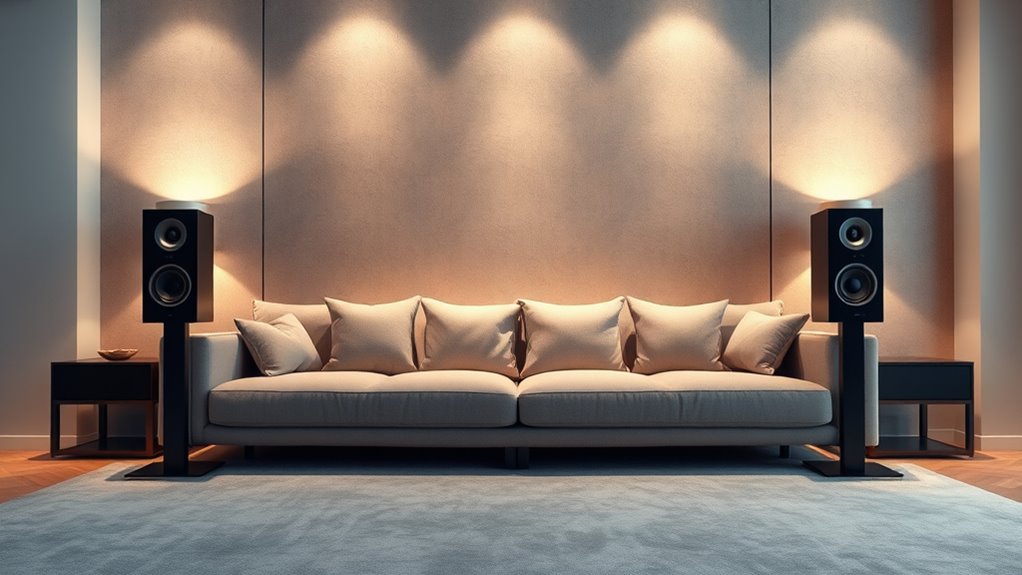
Choosing the right distance for your speakers is key to achieving balanced, accurate sound. Proper placement affects subwoofer calibration, ensuring bass sounds are tight and well-defined. Keep your speakers at ear level for ideal clarity and avoid placing them too close to walls, which can cause unwanted reflections. Adequate speaker isolation helps prevent vibrations from affecting sound quality, so position them on sturdy stands or mounts. Distance also impacts how sound waves interact; too close, and sound may be boomy or muddy, too far, and detail gets lost. Adjust your speaker placement gradually, listening for smooth, natural sound. Small changes in distance can considerably improve overall audio quality, making your listening experience more immersive and true to the original recording. Additionally, understanding the role of contrast ratio can help you optimize your home theater setup for the best possible sound and image clarity. Properly managing speaker placement can also minimize reflections and standing waves, leading to a more precise soundstage. Moreover, considering the specific speaker type and its characteristics can further enhance your sound setup for optimal performance. Being aware of grocery savings strategies can also help you allocate more resources toward quality audio equipment, improving your overall entertainment experience.
As an affiliate, we earn on qualifying purchases.
The Importance of Symmetry in Speaker Arrangement

Symmetry in your speaker arrangement creates a balanced visual appeal that makes your space look more inviting. It also improves sound imaging, making music and dialogue feel more natural and focused. When your speakers are aligned symmetrically, you’ll enjoy a consistent audio experience throughout the room. Additionally, maintaining symmetry can help optimize the acoustic environment, ensuring sound waves interact harmoniously for the best listening experience. Incorporating speaker placement principles can further enhance your setup by guiding optimal positioning for clarity and depth. Practicing mindful arrangement can lead to more sustainable and efficient use of space, maximizing both aesthetic and acoustic benefits. Furthermore, understanding AI-enhanced audio technology can assist in fine-tuning your setup for even better sound quality. Recognizing the importance of essential oils for acoustic health can also support a calming environment conducive to focused listening.
Balanced Visual Aesthetics
When arranging your speakers, maintaining balanced visual aesthetics enhances the overall look of your space. Symmetry plays a key role, creating a harmonious feel that’s pleasing to the eye. Focus on speaker grill aesthetics—choose options that blend seamlessly with your decor or opt for minimalistic designs. Color matched speakers help achieve a cohesive appearance, making them less obtrusive. Positioning your speakers with visual balance in mind guarantees they complement your room’s design rather than clash with it. Avoid asymmetrical setups that can distract or create visual tension. Instead, aim for matching or complementary speaker sizes and styles on either side of your listening area. This approach not only improves aesthetics but also encourages a sense of order and sophistication in your space. Additionally, proper speaker placement can significantly enhance sound quality by optimizing acoustic balance and clarity. Properly aligning speakers with symmetrical arrangements can help distribute sound evenly throughout the room, enhancing the overall listening experience. Incorporating cost variance analysis into your planning can also help you make informed decisions about speaker investments and room modifications. Understanding the importance of aesthetic harmony can further help you create a visually pleasing and acoustically optimized environment. Considering pediatric sleep specialists or other professionals for tailored advice can further optimize your setup and environment.
Enhanced Sound Imaging
Achieving balanced visual aesthetics sets the stage for better sound imaging, as symmetrical speaker placement allows sound waves to interact more evenly within the room. When your speakers are aligned symmetrically, it helps create a more accurate and immersive soundstage. Proper subwoofer calibration ensures deep bass frequencies blend seamlessly with the main speakers, enhancing clarity and depth. Additionally, soundproofing techniques can minimize external noise and prevent sound leakage, allowing you to experience cleaner audio. Symmetry in placement reduces phase issues and echoes, resulting in a more precise imaging of instruments and vocals. Room acoustics play a crucial role in optimizing sound quality by managing reflections and absorption. By focusing on these elements, you improve the overall sound quality and enjoy a richer, more natural listening experience. Incorporating professional consultation can further optimize your setup to achieve the best sound performance.
Consistent Audio Experience
Have you ever noticed how inconsistent sound can be when your speakers aren’t properly aligned? Achieving a consistent audio experience starts with symmetry in speaker placement. When speakers are evenly positioned and at the right height, sound waves reach your ears simultaneously, reducing distortions. To enhance this, consider speaker isolation—using stands or pads to prevent vibrations from affecting sound quality. Soundproofing techniques can also help, minimizing external noise that disrupts your listening. Proper isolation ensures that each speaker produces clear, balanced sound, maintaining consistency across your listening space. Remember, symmetrical setup not only improves sound imaging but also creates an immersive experience, making your audio feel natural and precise every time you listen.
stereo speaker mounting brackets
As an affiliate, we earn on qualifying purchases.
As an affiliate, we earn on qualifying purchases.
Positioning for Proper Stereo Imaging

To achieve proper stereo imaging, you should position your speakers in an equilateral triangle with your listening spot, ensuring they are the same distance apart as you are from them. Keep your ears level with the speakers for the best sound clarity and imaging accuracy. Make sure both speakers are symmetrically placed around your listening position to create a balanced soundstage.
Equilateral Triangle Setup
Positioning your speakers in an equilateral triangle shape is essential for creating accurate stereo imaging. This setup guarantees that your ears are equidistant from each speaker, producing a balanced soundstage. To optimize your setup:
- Place your speakers at equal distances from each other and your listening position.
- Adjust for proper subwoofer calibration to avoid muddy bass and ensure tight, accurate lows.
- Incorporate bass trapping around the room corners to minimize sound reflections that can distort stereo imaging.
- Keep the speakers at ear level, maintaining symmetry for consistent sound delivery.
Listener’s Ear Level
Are your speakers aiming to deliver the best stereo image? Position them so your ear level aligns with the tweeters. This guarantees sound hits your ears directly, creating a more accurate stereo image. Proper speaker height minimizes phase issues and helps you perceive spatial details clearly. Before adjusting, make sure your subwoofer calibration is refined, so bass blends seamlessly without overwhelming the stereo image. Also, consider bass trapping in your room to reduce low-frequency reflections that can muddy sound clarity. When your ears are at the same height as the tweeters, you’ll experience a more precise and immersive soundstage. Keep in mind that small adjustments can make a big difference, so experiment with height until your speakers are perfectly aligned with your ears for superior stereo imaging.
Symmetrical Placement
Achieving a balanced stereo image relies heavily on placing your speakers symmetrically within the room. Proper placement ensures even sound distribution and accurate imaging. To do this effectively:
- Position your speakers at equal distances from the listening spot, forming an equilateral triangle.
- Keep them at the same height, ideally ear level, for consistent sound.
- Align the speakers so they face directly toward you, avoiding angles that distort stereo imaging.
- Calibrate your subwoofer carefully to improve bass response, avoiding boominess or muddiness.
Symmetrical placement helps with subwoofer calibration, leading to tighter, more controlled bass. It also enhances overall sound clarity, making your listening experience more immersive and true to the original recording.
Adjusting Speaker Height and Angle
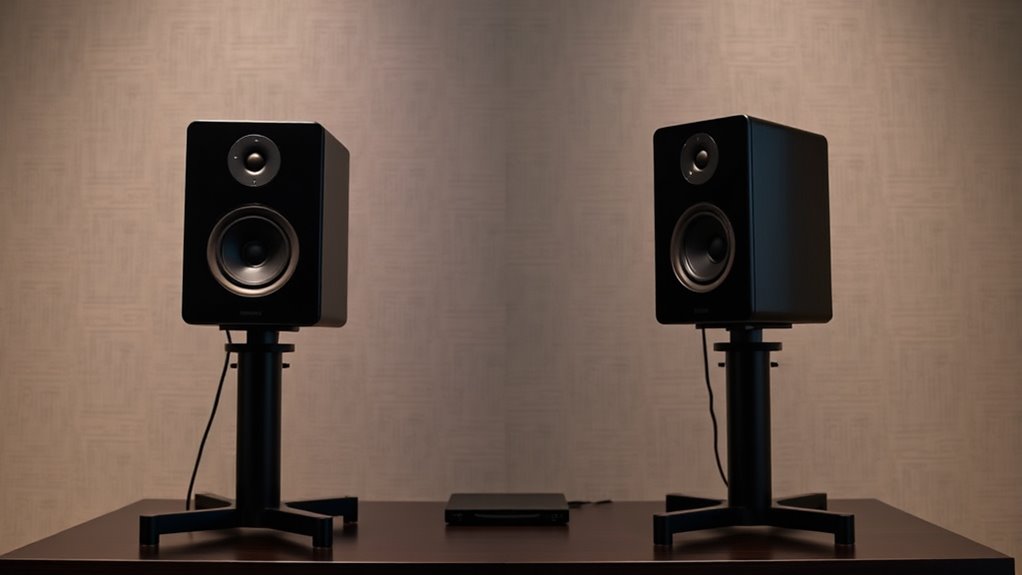
To get the best sound quality from your speakers, you need to carefully adjust their height and angle. Proper positioning ensures ideal sound reflection and effective subwoofer calibration, creating a balanced audio experience. Aim to align the tweeters at ear level for clear treble and focus the speakers toward your listening position. Experiment with slight tilt adjustments to reduce unwanted reflections that can muddy sound clarity. Remember, even small tweaks can make a big difference. Below is a table illustrating common adjustments:
| Adjustment Focus | Effect |
|---|---|
| Raising speakers | Improves high-frequency clarity |
| Angling toward ears | Enhances stereo imaging |
| Lowering speakers | Diminishes sound reflection issues |
| Tilting upward | Focuses sound directly at ear level |
| Fine-tuning angles | Perfects overall sound balance |
Minimizing Sound Reflections and Echoes
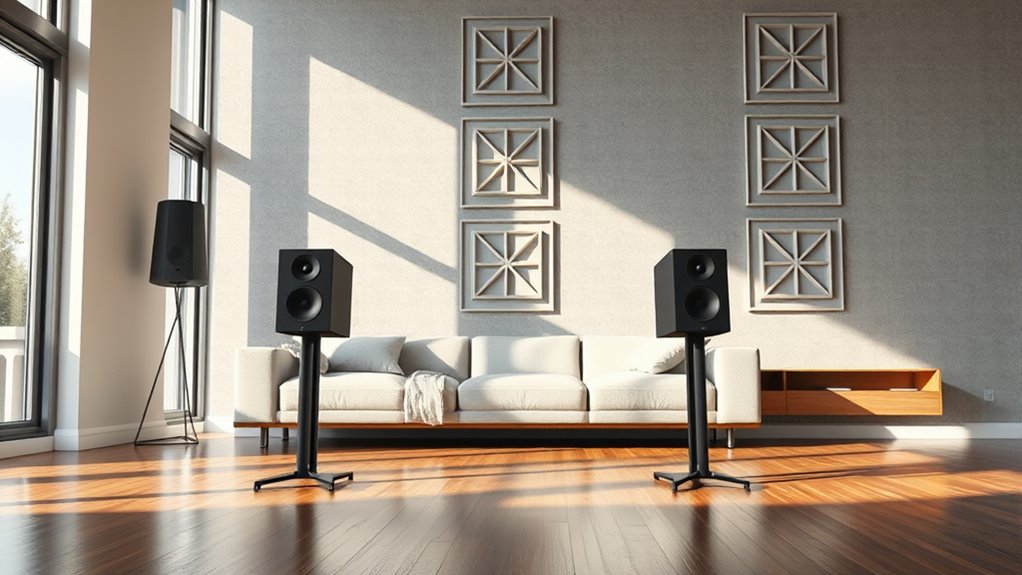
Sound reflections and echoes can considerably degrade your listening experience if left unaddressed. To improve sound clarity, focus on soundproofing techniques and acoustic treatment. Here are four effective steps:
- Add rugs or carpets to absorb sound and reduce bounce.
- Use acoustic panels on walls to minimize reflections.
- Incorporate heavy curtains or drapes, especially near windows.
- Place furniture strategically to break up sound waves and prevent echo.
These measures help control unwanted sound reflections, creating a cleaner, more accurate audio environment. You don’t need to overhaul your space—simple acoustic treatments and soundproofing techniques can make a significant difference in your listening experience. By reducing echoes, you’ll enjoy clearer sound and more immersive listening.
The Role of Subwoofers in Overall Sound Balance

Proper subwoofer placement is key to achieving balanced bass and clear sound. You should experiment with different positions to find where the bass sounds fullest without overwhelming the room. Keep in mind that room acoustics can substantially influence how your subwoofer performs.
Subwoofer Placement Strategies
The placement of your subwoofer has a significant impact on how balanced and immersive your overall sound experience becomes. To optimize bass response, consider these strategies:
- Place the subwoofer near a wall to enhance bass projection, but avoid corners to prevent overwhelming bass.
- Use subwoofer isolation pads to reduce vibrations and prevent sound distortion.
- Experiment with different spots to find where bass sounds fullest without muddying other frequencies.
- Avoid placing the sub too close to furniture or walls that can cause sound cancellation or reinforcement issues.
Balancing Bass Levels
Achieving a balanced overall sound depends heavily on how well your subwoofer integrates with the main speakers. Proper subwoofer calibration ensures that bass levels don’t overpower or underwhelm the rest of your audio. Start by adjusting the subwoofer volume to match the main speakers, creating a seamless progression between low and mid-range sounds. Pay attention to bass absorption; too much can cause muddiness, while too little results in a thin sound. Use test tones or calibration tools to fine-tune the subwoofer’s phase and crossover settings. This process helps distribute bass evenly across the listening space, preventing boomy or hollow spots. Consistent calibration guarantees a cohesive, rich sound experience that complements your entire speaker setup.
Room Acoustics Impact
Room acoustics play a crucial role in how your subwoofer contributes to overall sound balance. Poor acoustics can cause bass muddiness or uneven distribution. To improve this, consider these factors:
- Room size and shape: Larger or irregularly shaped rooms may require strategic subwoofer placement.
- Room decoration: Soft furnishings like curtains and rugs absorb sound, reducing echo and enhancing bass clarity.
- Speaker cable quality: Using high-quality cables ensures minimal signal loss, maintaining sound integrity.
- Placement near walls: Positioning your subwoofer close to walls or corners can boost bass response, but avoid placing it directly in a corner to prevent boomy sound.
Adjusting these elements helps your subwoofer blend seamlessly into the room’s acoustics, creating a balanced, rich sound experience.
Experimenting With Placement Using Test Sounds
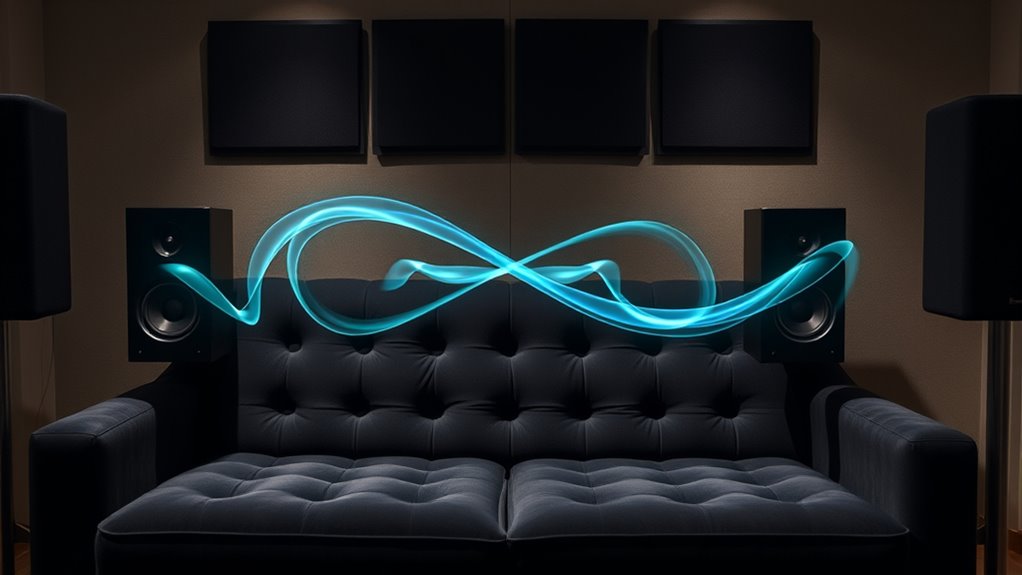
To find the best speaker placement, start by playing test sounds and carefully listening to how they fill the space. Use these sounds to identify areas where bass or treble might be weak or overwhelming. During this process, focus on subwoofer calibration to guarantee deep bass is balanced and clear. Adjust the subwoofer’s position gradually, listening for improved sound quality. Incorporate soundproofing techniques if you notice reflections or external noise affecting your tests. This might involve adding rugs, curtains, or panels to dampen unwanted echoes. Keep experimenting with different placements, moving speakers slightly and re-evaluating the sound. Your goal is to achieve an even, immersive soundstage where all frequencies blend seamlessly, giving you the best listening experience possible.
Common Mistakes to Avoid in Speaker Setup

One of the most common mistakes in speaker setup is placing speakers too close to walls or corners, which can cause exaggerated bass and muddy sound. To avoid this, pay attention to your subwoofer calibration and how it affects bass response. Here are key mistakes to watch out for:
Avoid placing speakers too close to walls or corners to prevent muddy sound and exaggerated bass.
- Ignoring proper speaker distances, leading to unbalanced sound.
- Overlooking the importance of toe-in, which affects stereo imaging.
- Neglecting room acoustics, causing echo and muddiness.
- Failing to optimize subwoofer placement, resulting in uneven bass response.
Fine-Tuning for Personal Preference and Space
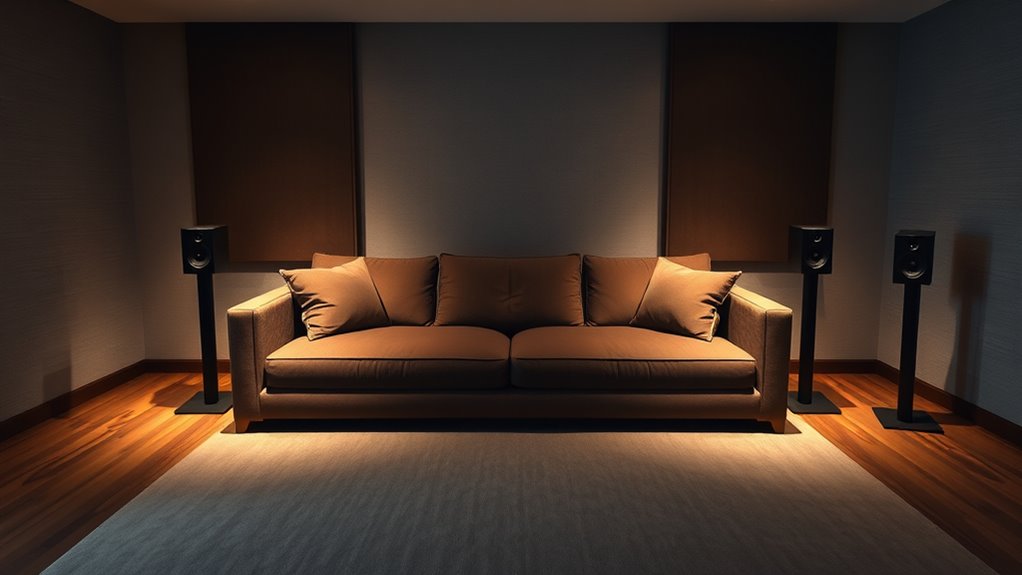
Achieving the best sound quality often requires tailoring your speaker setup to suit your personal preferences and the unique characteristics of your space. Start with subwoofer calibration to ensure your bass response is balanced and not overwhelming. Adjust the subwoofer’s volume and phase settings to match your main speakers, creating a seamless soundstage. Listen critically and fine-tune these settings until the bass feels natural and well-integrated. Consider the room’s acoustics—furniture, walls, and layout can affect sound. Don’t hesitate to experiment with speaker angles or slight repositioning to enhance clarity or bass response. Remember, small adjustments can make a significant difference, so take your time to personalize your setup for ideal, satisfying sound tailored to your space and preferences.
Frequently Asked Questions
How Does Furniture Placement Affect Speaker Sound Quality?
Furniture placement directly impacts your speaker sound quality by influencing acoustic reflections. If you position large furniture pieces too close to your speakers, it can cause sound reflections that muddy the audio clarity. To improve sound, arrange furniture to minimize these reflections, creating a more balanced and natural listening environment. Proper furniture positioning helps your speakers deliver clearer sound, enhancing your overall listening experience.
What Are the Best Materials for Speaker Stands or Mounts?
Your speakers deserve the best, or they’ll sound like they’re underwater! For speaker stand materials, opt for sturdy options like wood, metal, or high-density concrete, which provide stability and reduce vibrations. When choosing mounting bracket options, look for durable steel or aluminum, as they hold your speakers securely without wobbling. These materials guarantee crisp, clear sound and prevent unwanted resonance, making your listening experience truly extraordinary.
How Do Room Shape and Size Influence Speaker Placement?
Room shape and size greatly influence your speaker placement because they affect room acoustics and sound reflection. You should position your speakers to maintain symmetry, avoiding corners or uneven walls that cause echo or bass buildup. Larger rooms might need more space between speakers and walls, while irregular shapes can create dead spots. Adjust placement based on your room’s acoustics to achieve balanced sound and clear audio performance.
Can Speaker Placement Reduce Overall Listening Fatigue?
Think of speaker placement like tuning a fine instrument—when done right, it diminishes your listening fatigue. You enhance listener comfort and sound clarity by positioning your speakers to minimize harsh reflections and dead spots. Proper placement ensures the sound reaches you smoothly, much like a well-conducted orchestra. This way, your ears stay relaxed, and the listening experience remains enjoyable without overwhelming your senses.
What Tools or Apps Can Assist in Optimal Speaker Positioning?
You can use virtual room calibration tools and speaker positioning apps to find the best setup. These tools analyze your room’s acoustics and suggest ideal speaker placement, helping you achieve balanced sound. Apps like Room EQ Wizard or Dirac Live streamline the process, making it easier to fine-tune your speakers. With their guidance, you’ll enjoy clearer audio and reduce listening fatigue, all without complicated manual adjustments.
Conclusion
So, after all this, remember that perfect sound isn’t about following every rule blindly. Sometimes, the best listening spot is where things don’t seem ideal—yet, that’s where your ears find magic. Don’t get too caught up in symmetry or angles; your space and taste matter most. Ironically, the more you experiment, the closer you get to that elusive “perfect” sound. Sometimes, imperfection is actually the secret to true audio bliss.
Halloween Picks
halloween
As an affiliate, we earn on qualifying purchases.