Getting into hi-fi means understanding key terms like fidelity, soundstage, and distortion, which describe how accurate and immersive your music can be. You’ll hear about components like amplifiers, preamps, and speakers that shape sound quality. Knowing differences between digital and analog, as well as various cables and connectors, helps you make better choices. If you explore more, you’ll gain the knowledge to build a setup that truly enhances your listening experience.

Get furniture and decor delivered free with Prime
- Fast, free delivery on millions of items
- Prime Video, Amazon Music and more included
- Member-only deals all year
Key Takeaways
- Hi-Fi audio emphasizes high fidelity, accurate sound reproduction, and immersive sound staging to replicate the original recording.
- Essential components include amplifiers, preamplifiers, and speakers, each contributing to sound clarity and quality.
- Understanding audio cables and connectors (RCA, XLR) ensures proper signal transmission and compatibility.
- Digital formats (lossless vs. compressed) affect sound quality and file size, with lossless offering higher fidelity.
- Proper speaker and headphone placement enhances soundstage, clarity, and emotional engagement for a better listening experience.
As an affiliate, we earn on qualifying purchases.
What Is Hi-Fi Audio?

What exactly is Hi-Fi audio? It’s all about achieving high audio fidelity, meaning your sound is clear, detailed, and true to the original recording. When you listen to Hi-Fi, you experience music as it was meant to be heard, with minimal distortion. Sound staging is a key aspect, creating a sense of space and dimension so you can pinpoint where each instrument and vocal sits in the mix. This immersive experience makes you feel like you’re right there in the studio or concert hall. Hi-Fi isn’t just about loud volume; it’s about quality and accuracy. When you invest in Hi-Fi audio, you’re prioritizing true-to-life sound, capturing nuances that ordinary systems often miss. Understanding the appropriate headphone connection can also enhance your listening experience by ensuring optimal sound quality and comfort. Additionally, choosing the right audio components is essential for achieving the best fidelity and personalized sound signature. Selecting the proper audio source can further improve overall clarity and detail in your listening setup, especially when considering the impact of battery technologies on portable audio devices.
As an affiliate, we earn on qualifying purchases.
Key Components of a Hi-Fi System

When setting up a Hi-Fi system, your amplifiers and preamplifiers play a vital role in shaping the sound. The speakers and their cabinets directly affect the clarity and richness of your audio experience. Understanding how these key components work together helps you create a balanced and high-quality setup. Additionally, selecting appropriate tableware materials can enhance the aesthetics of your listening space, creating an inviting environment for enjoying music. Moreover, considering the contrast ratio of your speakers and components can significantly influence the perceived depth and detail in your audio playback. Incorporating automation in audio settings can further optimize your listening experience by adjusting parameters in real-time for the best sound quality.
Amplifiers and Preamplifiers
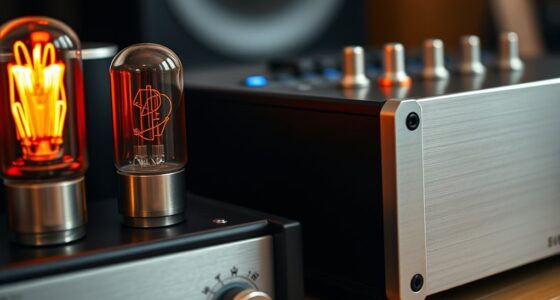
Amplifiers and preamplifiers are essential components that power and shape the sound in a hi-fi system. They boost audio signals to drive your speakers and add character to your listening experience. Tube amplifiers are popular for their warm, natural sound, making them a favorite among audiophiles. Integrated receivers combine a preamp and amplifier into one unit, simplifying setup and saving space. These receivers often include built-in tuners and multiple input options, making them versatile. The preamplifier handles input selection and volume control, while the main amplifier increases signal strength. Choosing the right combination depends on your preferences and budget. Together, these components guarantee your music sounds clear, dynamic, and engaging, forming the backbone of your hi-fi system.
Speakers and Cabinets
Speakers and cabinets are the final links in your hi-fi system, transforming amplified signals into the sound you hear. Proper speaker placement is vital; position your speakers at ear level and keep them an appropriate distance apart to create a balanced soundstage. Experiment with angles and distances to find the sweet spot. The cabinet materials influence sound quality—wooden cabinets, for example, often produce warmer tones, while metal or plastic can add brightness. Avoid placing speakers too close to walls or corners, as this can cause unwanted bass resonance or distortion. Choosing the right cabinets and arranging your speakers thoughtfully ensures you get clear, accurate audio and an immersive listening experience. Small adjustments can make a significant difference in sound clarity and overall system performance.
As an affiliate, we earn on qualifying purchases.
Understanding Sound Quality Terms

Understanding sound quality terms is essential for appreciating the nuances of high-fidelity audio. When you grasp concepts like sound wave physics, you can better understand how sound travels and interacts within your system. Terms such as “clarity,” “warmth,” and “detail” describe how accurately audio reproduces the original recording. Audio fidelity benchmarks serve as standards to measure how closely your system’s sound matches the source. These benchmarks include frequency response, total harmonic distortion, and dynamic range. Recognizing these terms helps you evaluate equipment objectively and choose components that enhance your listening experience. Additionally, understanding sound wave physics can deepen your comprehension of how different frequencies and amplitudes affect perceived sound quality. Exploring acoustic environments can also optimize your listening space by minimizing sound reflections and reverberations. For example, knowing how room acoustics impact sound can lead to better placement of speakers and acoustic treatment. Furthermore, understanding comfort and support solutions can help optimize your listening environment by reducing physical discomfort and distractions. By understanding the language used in the hi-fi world, you gain confidence in making informed decisions and appreciating the subtle differences in sound quality.
As an affiliate, we earn on qualifying purchases.
Common Types of Audio Cables and Connectors

Choosing the right audio cables and connectors is essential for getting the best sound quality from your setup. Different cable types serve specific purposes, and connector compatibility can impact performance. Understanding these options helps you make informed choices to optimize your hi-fi system. Additionally, selecting high-quality audio patches can contribute to a clearer and more immersive listening experience. Being aware of regional legal resources can also assist in troubleshooting or enhancing your setup through expert advice or local support. Proper cable management can prevent interference and maintain signal integrity, ensuring optimal audio performance.
Cable Types and Uses
Have you ever wondered which audio cables deliver the clearest sound and easiest setup? The right cable type can make a big difference in your hi-fi system. For example, speaker cables vary in design to optimize speaker placement and minimize interference. High-quality cables often feature superior cable shielding, reducing noise and preserving audio fidelity. When choosing cables, consider these options:
- Speaker cables: Designed for speaker placement, often thicker with good shielding to prevent signal loss.
- RCA cables: Common for connecting components, offering decent shielding for clearer sound.
- XLR cables: Used in professional setups, providing balanced connections and excellent shielding against interference. Using appropriate cable shielding can significantly improve your listening experience by minimizing external noise. Selecting the right cable type ensures your system performs at its best, with minimal noise and maximum clarity. Additionally, understanding the types of audio cables can help you make more informed choices based on your equipment and setup needs.
Connector Varieties and Compatibility
Selecting the right audio connectors is essential for ensuring your equipment works seamlessly together. Different connector types serve specific purposes and compatibility considerations guide your choices. For example, RCA connectors are common for stereo signals, while XLR connectors provide balanced audio for professional gear. Understanding connector varieties helps prevent connection issues and preserves sound quality. Additionally, being aware of vetted options can help you choose the most reliable and compatible connectors for your setup. Recognizing the technical specifications of each connector type ensures optimal performance and longevity of your audio system.
Amplifiers, Receivers, and Preamplifiers Explained

To understand how your hi-fi system amplifies sound, it’s essential to grasp the roles of amplifiers, receivers, and preamplifiers. An amplifier increases the audio signal’s power, driving your speakers. Receivers combine amplification with radio tuning and input switching, acting as a central hub. Preamplifiers prepare low-level signals for amplification, often including tone controls and inputs. Tube amps are popular for their warm sound, utilizing vacuum tubes instead of solid-state components. Power supplies are critical, providing stable energy to ensure clean output. Additionally, understanding payment processing concepts can help in managing the technical infrastructure of modern audio equipment. As with AI systems, ensuring trustworthiness and safety measures in your audio setup can prevent potential issues and improve overall performance. Recognizing the importance of grounding and shielding can also minimize electrical noise and interference in your hi-fi system.
The Role of Speakers and Headphones

Ever wondered how your audio reaches your ears with clarity and depth? It’s all about the right speaker placement and headphone ergonomics. Proper speaker placement ensures sound fills your space evenly, creating a realistic experience. Headphones should fit comfortably, so they don’t distract you from your music’s details. When these elements are optimized, your listening becomes immersive and precise. Consider this emotional impact:
| Clarity | Comfort | Immersion |
|---|---|---|
| Crisp sound | No fatigue | Deep connection |
| Pure tones | Perfect fit | True-to-life experience |
| Balanced soundstage | Long-lasting comfort | Enhanced enjoyment |
Getting these right makes every note resonate emotionally, transforming your listening from mere sound into a vivid experience.
Digital vs. Analog Audio: What’s the Difference?

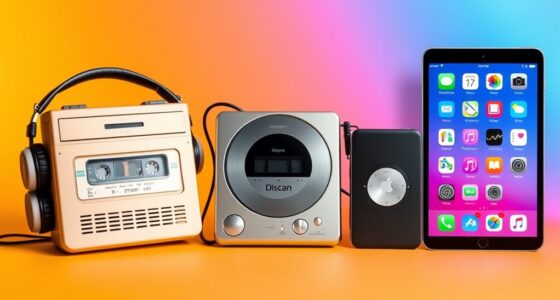
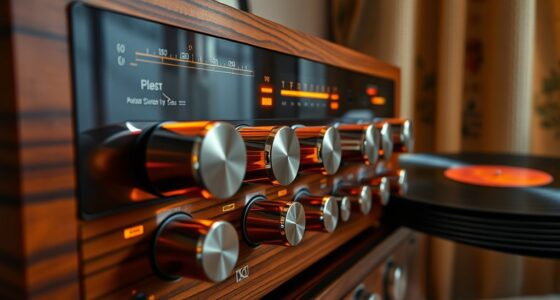
Have you ever wondered what makes digital and analog audio different in how they capture and reproduce sound? Digital audio records sound as data—think digital streaming—offering convenience and consistency. In contrast, analog audio captures sound waves directly, like vinyl records, which have experienced a vinyl resurgence among enthusiasts.
Digital audio offers convenience and clarity, while analog captures the warmth and nuance of live sound.
Key differences include:
- Signal quality: Analog preserves the warmth and nuances of live sound, while digital offers clarity and noise-free playback.
- Durability: Digital files are less prone to degradation, whereas vinyl can wear over time.
- Format flexibility: Digital formats allow easy storage and sharing, unlike analog media, which requires physical handling.
Understanding these distinctions helps you appreciate why many audiophiles prefer analog for its rich sound, despite the convenience of digital streaming.
Playing Music Files: Lossless vs. Compressed Formats

When choosing how to play your music files, understanding the difference between lossless and compressed formats is essential. Lossless audio file formats preserve all original data, offering the highest sound quality without data compression. Compressed formats reduce file size through data compression, often sacrificing some audio fidelity for convenience.
| Format Type | Example Files | Key Feature |
|---|---|---|
| Lossless | FLAC, ALAC | No data loss, high quality |
| Compressed | MP3, AAC | Smaller files, some data loss |
| Both | WAV, OGG | Vary in compression, flexibility |
Choosing the right format depends on your priorities—sound quality or storage. Lossless files give you pristine audio, while compressed formats are more portable and take up less space.
Tips for Choosing Your First Hi-Fi Setup

Choosing your first hi-fi setup can seem overwhelming, but focusing on a few key factors makes the process manageable. Start by considering your space and how speaker placement affects sound quality; positioning speakers at ear level and forming an equilateral triangle with your listening position enhances clarity. Pay attention to room acoustics, as furniture, curtains, and wall treatments can influence sound reflection and absorption. To optimize your setup, keep in mind:
- Adjust speaker placement to reduce echo and bass muddiness
- Use rugs or curtains to improve room acoustics
- Experiment with speaker angles and distances for the best soundstage
Frequently Asked Questions
How Do Room Acoustics Affect Hi-Fi Audio Quality?
Room acoustics substantially impact your hi-fi audio quality by influencing room reflection and sound clarity. When reflections bounce off walls, they can create echoes or muddiness, reducing detail. Acoustic treatment helps control these reflections, improving sound accuracy and imaging. Properly managing room acoustics ensures your speakers sound their best, providing a more immersive listening experience with clearer, more precise audio.
What Is Speaker Impedance and Why Is It Important?
Speaker impedance, or resistance, determines how much load your speaker places on your amplifier. It’s important because matching impedance ensures efficient power transfer and prevents damage. If your amplifier’s impedance isn’t compatible with your speaker’s impedance, sound quality suffers, or you risk damaging your gear. Always check and match the impedance specifications to guarantee ideal performance and longevity for your hi-fi system. Proper impedance matching keeps your sound clear and your equipment safe.
How Do I Troubleshoot Audio Issues in My System?
Like a detective uncovering clues, start troubleshooting your audio by checking connections and cables, as cable upgrades can fix static or distortion. Make certain your power supply isn’t causing issues, such as hum or dropouts. Switch inputs, test different sources, and listen for shifts. If problems persist, inspect for loose connections or damaged components. Remember, patience and systematic checks help you restore harmony to your sound system.
What Are the Differences Between Tube and Solid-State Amplifiers?
Tube amplifiers often provide a warmer, richer sound with lower distortion levels, making music feel more natural and inviting. They typically have a softer power output, which can slightly limit volume at high levels. Solid-state amplifiers usually deliver higher power output and produce very low distortion, resulting in cleaner, more precise sound. Your choice depends on whether you prefer a cozy, vintage vibe or a more powerful, accurate audio experience.
Can I Upgrade My System Gradually Without Replacing Everything?
Sure, you can upgrade your system gradually—who doesn’t love a never-ending project? Focus on modular upgrades to enhance sound quality step-by-step, and always check component compatibility before swapping parts. This way, you avoid the chaos of incompatible gear or wasted money. Your system will evolve naturally, giving you the thrill of improvement without the hassle of a full overhaul. Happy upgrading!
Conclusion
Diving into hi-fi might seem overwhelming, but understanding the basics helps you make smarter choices. Many believe that high-end gear guarantees perfect sound, but research shows that matching components to your space and preferences matters more. Trust your ears over specs alone. With patience and curiosity, you’ll discover what truly sounds good to you. Remember, the best setup is the one that makes your favorite music come alive—so enjoy the journey!
Halloween Picks
halloween
As an affiliate, we earn on qualifying purchases.