TL;DR

Get furniture and decor delivered free with Prime
- Fast, free delivery on millions of items
- Prime Video, Amazon Music and more included
- Member-only deals all year
Richard E. Grant’s circus-inspired dining area has drawn attention after an Instagram photo showed the actor hosting friends. Interior designers praised its humour and personal character, while recommending smaller ways to borrow the look without copying the whole room.
An Instagram photo of Richard E. Grant hosting a dinner party has put his circus-inspired dining area in the spotlight, with interior designers praising its character, humour and relaxed feel. The room’s theatrical decorations offer ideas for entertaining, but the experts say homeowners do not need to reproduce its maximalist style to take inspiration from it.
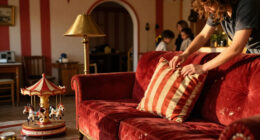
The photo, described in a report by Ideal Home, shows Grant at a dinner with friends. The publication identifies Helena Bonham Carter and Christine Baranski among the guests. Attention in the image turns to the room as well as the company: its visible details include circus-inspired masks, bunting, colourful lighting and garlands, alongside hydrangeas, houseplants and mismatched servingware.
Interior designer Lia Gold, a winner of BBC One’s Interior Design Masters, described the room as an expression of its owner rather than a carefully followed trend. She said it is “kooky” and “a little bit mad,” adding that the décor extends Grant’s personality into the home. Gold also pointed to its potential as a setting for conversation, with unusual objects giving dinner guests things to notice and discuss.
Alison Westaby, head of interior design at Barker and Stonehouse, said the room appears comfortable and used rather than arranged only to look good in photographs. Its humour, she said, helps make the space feel less formal. The designers’ advice for readers is to begin with a detail they genuinely like—such as bunting, an ornament or distinctive servingware—and build gradually, rather than trying to recreate Grant’s dining area wholesale.
A Personal Room for Entertaining
The attention to Grant’s dining room speaks to a practical question for hosts: how to make a room welcoming without aiming for a flawless, coordinated finish. The designers featured by Ideal Home argue that comfort and personality can matter more than polish, particularly in a space intended for people to gather and spend time together.
The room also shows how decorative choices can serve a social purpose. Bunting, colourful objects and striking wall pieces give guests topics to talk about, while plants and familiar tableware keep the setting from reading as a display. For readers who prefer quieter interiors, the point is not that every dining room needs circus motifs. It is that one or two personal touches can make a hosting space feel less formal and more individual.
As an affiliate, we earn on qualifying purchases.
From Home Style to Trend Talk
Ideal Home frames the dining room as part of a broader pattern in Grant’s home, citing other expressive choices such as a hot-pink snug, garden decorations and distinct areas in the garden. The report presents these details as evidence of a personal decorating style that is not led by conventional trend rules.
The article also connects the room to FunHaus, a circus-inspired trend that it says Pinterest declared would be prominent in 2026. That is the publication’s comparison, not evidence that Grant designed his dining room in response to the trend. The report suggests the resemblance may be incidental: the room reflects the actor’s taste and approach to entertaining, rather than an announced effort to follow a forecast.
““It’s a reflection of the person who lives there.””
— Lia Gold, interior designer and winner of BBC One’s Interior Design Masters, quoted by Ideal Home
As an affiliate, we earn on qualifying purchases.
What the Photo Does Not Show
The report describes details visible in an Instagram post, but it does not give the date the photo was taken or posted, nor a full account of the room’s design history. It is also unclear whether Grant intentionally drew on circus design or the FunHaus trend. The article’s trend comparison is editorial context, not a statement from Grant about his intentions.
The photograph and expert commentary cannot establish how the room looks in every season or how it is used outside the dinner shown. The report does not include a direct comment from Grant about the décor. Its descriptions of the space and its entertaining qualities should be understood as observations from the publication and the quoted designers.
As an affiliate, we earn on qualifying purchases.
Ideas Readers Can Try at Home
Ideal Home’s report offers no announced project or follow-up from Grant. For readers, the next step is simply to take a small idea from the room: use a favourite ornament as a table centrepiece, add bunting, choose distinctive servingware or bring in artwork with a bolder colour.
Gold recommends starting with items a host genuinely enjoys. Westaby suggests combining older and newer pieces, using plants to add height and softness, and repeating a colour, material or shape to link varied elements. The emphasis is on testing personal touches at a manageable scale, then deciding whether they suit the room and the people who use it.
As an affiliate, we earn on qualifying purchases.
Key Questions
What does Richard E. Grant’s dining area look like?
Ideal Home describes a circus-inspired, theatrical room with masks, bunting, colourful lighting and garlands, as well as plants, hydrangeas and mismatched servingware.
Why have designers praised the room?
Lia Gold and Alison Westaby praised its personal character, humour and relaxed atmosphere. They said its decorations can encourage conversation without making the room feel overly formal.
Does Grant’s room follow the FunHaus trend?
Ideal Home compares the room with the circus-inspired FunHaus trend it says Pinterest named for 2026. The report does not say Grant intentionally followed that trend, and it gives no direct comment from him on the design’s inspiration.
How can someone try the look without going maximalist?
The designers suggest beginning with one or two details, such as bunting, a distinctive ornament, colourful artwork or unusual servingware. Westaby also recommends using plants and repeating a colour, shape or material to connect different pieces.
Source: rss
Halloween Picks
halloween
As an affiliate, we earn on qualifying purchases.