
TL;DR

Get furniture and decor delivered free with Prime
- Fast, free delivery on millions of items
- Prime Video, Amazon Music and more included
- Member-only deals all year
Natalie Turner, principal designer at Dovetail Studio, used ChatGPT to visualize bold stripes for an archway in her home before painting them. She says the mock-up helped her refine the design and extend the stripes onto a nearby wall; her paint-preparation method used the existing wall color to help achieve crisp edges.
Oklahoma City designer Natalie Turner used ChatGPT to visualize bold stripes on an archway in her home before painting the entryway, according to a recent Apartment Therapy report. The project shows how she used an AI-generated rendering to refine a design idea, including extending the pattern onto an adjacent wall to account for the home’s rounded drywall corners.
Turner, principal designer and founder of Dovetail Studio, wanted to draw attention to an arched opening between a side entryway and her kitchen. She had already settled on stripes as a way to add what she called “extra detail,” but asked ChatGPT to create a visual rendering before committing to paint. Turner told Apartment Therapy that she also uses the tool to make mock-ups for clients, so they can see proposed ideas rather than relying on written descriptions alone.
The finished pattern pairs Sherwin-Williams Tricorn Black (SW 6258) with Natural Choice (SW 7011), the warm neutral already used on nearby walls. Turner said she chose stripe widths that related to the trim and baseboards, aiming for a strong pattern that would not feel too busy. She also carried the design beyond the archway onto a nearby wall, where the stripes would remain visible around the rounded drywall corners.
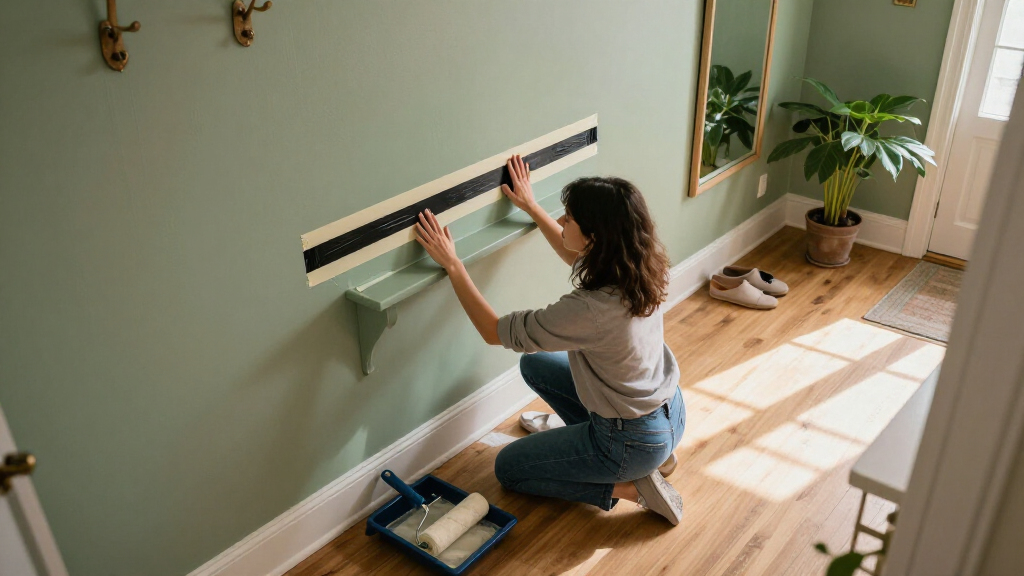
For sharper paint lines, Turner said she applied painter’s tape, then brushed the existing wall color along the tape edges before using the contrasting black paint. That first coat, she said, seals small gaps where the darker paint might otherwise seep under the tape. Apartment Therapy’s report describes the technique as Turner’s advice for this project; it does not provide independent testing of the result or a comparison of the time saved.
A Mock-Up Before the First Brushstroke
The project is a specific example of AI being used as a design-visualization aid, rather than as a substitute for the designer’s choices or the painting itself. Turner had the core concept before turning to ChatGPT; the rendering helped her see how the stripes might work in the actual space and consider adjustments before buying into the design with paint.
That distinction may matter to homeowners weighing whether to use image-generation tools for DIY planning. A visualization can help communicate scale, color, and placement, but the source account does not establish that the rendering accurately reproduced the finished room or that AI alone produced the final design. Turner selected the colors and pattern scale, and made the decision to extend the stripes in response to the architecture.
The report also offers a practical takeaway for people considering a high-contrast paint pattern: careful layout and preparation affect the finish. Turner’s suggested method uses the existing wall color to seal tape edges before applying the darker stripe, while her choice of a restrained two-color palette keeps the pattern connected to the adjoining kitchen.
As an affiliate, we earn on qualifying purchases.
From Archway Idea to Painted Pattern
Apartment Therapy published the account as a home makeover and DIY report, featuring Turner’s own entryway and comments about her design process. The article notes that she works with clients through Dovetail Studio and uses ChatGPT visuals to show possible design ideas. It does not present the project as a formal product test, nor does it report an evaluation of ChatGPT’s image accuracy.
Turner described stripes as adaptable, saying they can read as traditional, whimsical, or sophisticated depending on how they are used. For this project, she chose black against a warm neutral already present in the home, rather than adding another color. The source also suggests alternatives for homes without archways, including a striped accent wall, the back of a bookshelf, furniture upholstery, or peel-and-stick wallpaper cut into strips.
As an affiliate, we earn on qualifying purchases.
What the Report Does Not Establish
The source does not give the project’s cost, exact dimensions, or a measured estimate of how much time the ChatGPT rendering saved. Turner said the approach made the DIY easier, but the report provides no before-and-after timing or independent assessment. It is also unclear which prompt or image-generation settings she used, how closely the rendering matched the completed entryway, or whether the same method would produce reliable results in other rooms.
The account is based on Turner’s description of her own project. It does not establish that AI visualization will work equally well for every home or that the tape-sealing technique guarantees clean lines; surface condition, materials, and application can differ.
As an affiliate, we earn on qualifying purchases.
Options for Other Entryways
Apartment Therapy’s report offers alternatives for people who want a similar look without an arch: try stripes on a smaller accent wall, bookshelf backing, or furniture, or use peel-and-stick wallpaper cut into individual bands. Turner suggested wallpaper as a way to create a striped effect without painting directly onto the wall.
No further project update or follow-up from Turner is included in the source. For readers planning a comparable paint job, the next practical steps are to test the colors in the room, decide on a stripe width that fits nearby architectural details, and prepare the surface and tape carefully before applying the contrasting coat.
AI visualization tools for interior design
As an affiliate, we earn on qualifying purchases.
As an affiliate, we earn on qualifying purchases.
Key Questions
Who created the striped entryway?
Natalie Turner, principal designer and founder of Oklahoma City-based Dovetail Studio, painted the striped archway in her own home, according to Apartment Therapy.
How did ChatGPT contribute to the project?
Turner used ChatGPT to create a visual rendering of her stripe idea before painting. She said the concept was hers and that the rendering helped her preview how it might look.
Which paint colors did Turner use?
The stripes use Sherwin-Williams Tricorn Black (SW 6258) and Natural Choice (SW 7011), the warm neutral already used on nearby walls.
How did she aim for clean paint lines?
Turner said she used painter’s tape and brushed the existing wall color along its edges first. After that layer dried, she applied the contrasting black paint, a step intended to seal small gaps beneath the tape.
Can the look work without an archway?
Turner suggested using stripes on an accent wall, bookshelf backing, or furniture, or cutting peel-and-stick wallpaper into strips. These are ideas from the report, not tested results for every surface or room.
Source: rss
Halloween Picks
halloween
As an affiliate, we earn on qualifying purchases.