
TL;DR

Get furniture and decor delivered free with Prime
- Fast, free delivery on millions of items
- Prime Video, Amazon Music and more included
- Member-only deals all year
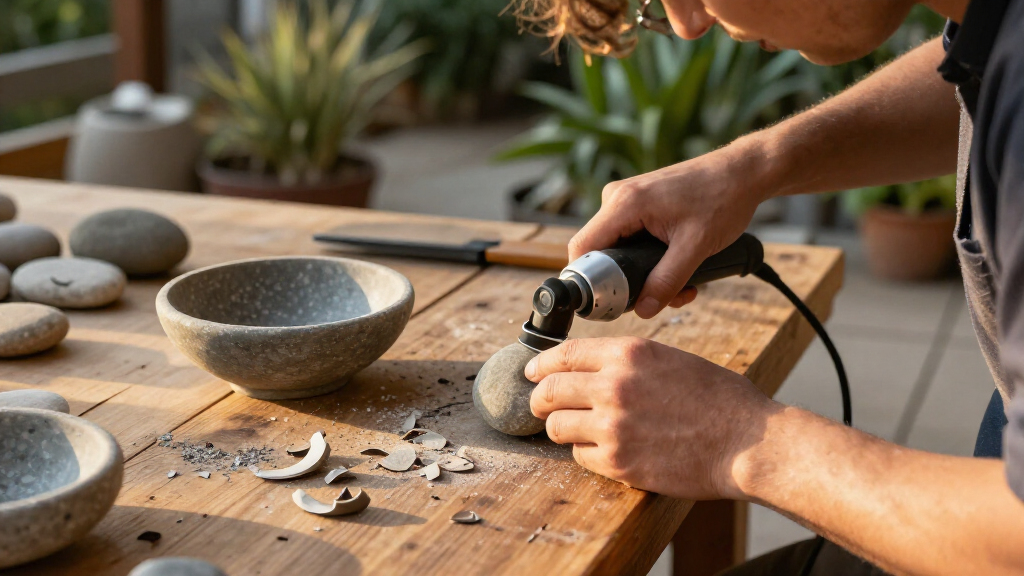
Architect and designer Ben Uyeda demonstrated carving smooth river rocks into bowls with an angle grinder and a diamond tile blade. The method can produce decorative vessels, but the source report cautions that river stone may be porous and says food use requires attention to testing and a suitable food-safe finish.
Architect and designer Ben Uyeda demonstrated carving river rocks into bowls with an angle grinder and diamond tile-cutting blade, a DIY method highlighted in a Hunker report. The project offers a way to make decorative stone vessels, but using a porous, untested rock for food raises sanitation and material-safety concerns, according to the report.
In a TikTok video titled “I [am] carving rocks into bowls using my @RYOBI Tools USA angle grinder,” Uyeda shows the process on large, smooth stones intended for a restaurant project. The source says he supports the stone in a sandbox, which holds the irregular rock in place while he works. He also suggests flattening the base so the finished bowl can sit more steadily.
For a smaller bowl, Uyeda makes a series of cuts in a radial pattern with a diamond tile blade. He then uses a hammer and chisel to remove the cut sections and create a rough hollow, before grinding the depression smoother. For a larger, oblong bowl, the report says he cuts a grid into the stone before removing material. Uyeda also mentions a diamond ball grinder with an extension shaft as another possible carving tool.
The report stresses that making a cavity does not make a stone suitable for serving food. It says Uyeda recommends sending rock samples for laboratory testing and applying a food-safe finish if the bowl will be used with food. The source warns that porous surfaces can be difficult to clean and sanitize, and that the appropriate sealant can add significant cost.
Food Safety Changes the DIY Equation
The project’s appeal is its use of an ordinary found material to make a vessel with a distinctive stone appearance. But the difference between a decorative bowl and a food-serving bowl is more than cosmetic. A rock’s origin and composition may not be evident from its appearance, and a rough or porous interior can make cleaning harder. The source says testing and a food-safe finish are relevant precautions; it does not provide laboratory results for Uyeda’s stones or establish that any particular river rock is safe to serve food from.
That uncertainty matters for people considering the project at home. A bowl used for keys or other household items avoids direct food contact, while serving food brings questions about contaminants, sanitation and the suitability of the finish. The report gives a retail example of a pint of MORE Stone Sealer priced at $55.63 at Walmart, underscoring that a protective coating may cost more than a low-priced finished bowl. The figure is a cited example, not a general price estimate for all sealers.
food safe stone sealer for river rocks
As an affiliate, we earn on qualifying purchases.
As an affiliate, we earn on qualifying purchases.
From Stone Carving to Tableware
Uyeda’s video frames the carving as a practical project for a restaurant at a hotel he is building. The Hunker report describes the result as a route to a high-end look, while noting that stone bowls vary widely in price depending on size and workmanship. It cites prices ranging from $8.99 to $2,800; the source does not identify a single market listing or specify a date for those prices.
The carving approach is one use of stoneworking tools, rather than a technique limited to bowls. The report says artisans, including Vladislav Savchenko, use related methods to make items such as sinks, plates, mugs, vases, candle holders and sculptures. These examples provide context for the material’s decorative potential, but they do not establish that all carved stone products are appropriate for food or drink.
““I [am] carving rocks into bowls using my @RYOBI Tools USA angle grinder.””
— Ben Uyeda, in the TikTok video described by Hunker
diamond tile cutting blade for angle grinder
As an affiliate, we earn on qualifying purchases.
As an affiliate, we earn on qualifying purchases.
Rock Safety Depends on Testing
The source does not say what kind of rock Uyeda used, identify the results of any laboratory tests, or name a specific finish applied to the bowls. It also does not establish that every river rock contains harmful substances; its concern is that composition and contamination cannot reliably be determined from appearance alone. The report discusses possible mineral and pollution risks but provides no test data for the stones in the video.
It is also unclear whether the bowls shown were intended for direct food contact after testing and sealing, or whether they were primarily made as restaurant décor. The source offers no detailed cleaning protocol, testing standard, or independent assessment of a finished bowl’s safety. A food-safe label on a coating alone would not, based on the report, settle questions about the underlying stone or how well the piece can be cleaned.
rock carving tools for DIY projects
As an affiliate, we earn on qualifying purchases.
As an affiliate, we earn on qualifying purchases.
Choose a Decorative or Food Use
The next step for anyone copying the project is to decide whether the bowl will be decorative or used with food. For a food-contact use, the report points to rock testing and a food-safe finish as precautions, but it does not name a testing laboratory or provide a standard that readers can follow. The stone’s suitability, the finish’s directions and the completed bowl’s cleanability remain matters to verify before serving food from it.
For a decorative bowl, the same carved form can hold keys or other household objects without being presented as tableware. The source does not announce a product launch, a new safety certification or further testing results. Any such information about Uyeda’s restaurant project or the specific bowls remains unreported.
laboratory tested food safe stone bowls
As an affiliate, we earn on qualifying purchases.
As an affiliate, we earn on qualifying purchases.
Key Questions
What tools did Ben Uyeda use to carve the river-rock bowls?
The Hunker report says he used an angle grinder with a diamond tile-cutting blade, followed by a hammer and chisel to remove stone. Uyeda also mentioned a diamond ball grinder with an extension shaft as another option.
How does the carving process create the bowl’s hollow?
For a smaller bowl, the described method uses radial cuts, then breaks out the cut stone with a hammer and chisel to form a rough depression. The maker grinds the hollow smoother afterward. A larger bowl can start with a grid of cuts.
Can any river rock bowl be used for food?
The source does not establish that any particular stone is safe. It says Uyeda recommends laboratory testing and a food-safe finish, and warns that porous stone can be difficult to sanitize. The specific rock and finished bowl would need assessment.
What is a safer non-food use for a carved rock bowl?
The report suggests using a finished bowl for decorative or household storage, such as holding keys. That avoids treating an unverified stone vessel as food-safe tableware.
Source: rss
Halloween Picks
halloween
As an affiliate, we earn on qualifying purchases.