TL;DR

Get furniture and decor delivered free with Prime
- Fast, free delivery on millions of items
- Prime Video, Amazon Music and more included
- Member-only deals all year
A Veranda report examines how art in the home may affect mood, drawing on comments from art historian Susie Hodge and decorator Cameron Jones. They describe possible responses to color and form, while stressing that reactions vary with personal experience and preference.
A report by Veranda describes how art displayed at home may shape how people feel, drawing on the views of art historian and author Susie Hodge and interior decorator Cameron Jones. For guidance on choosing art, see how to know if a piece of art is “the one”. They say color, shapes and personal associations can affect a viewer’s response, but neither expert presents a single artwork or palette as likely to produce the same emotion in everyone.
Hodge says that looking at art a person finds pleasing can produce a dopamine response, one consideration among others when deciding whether art is a good investment. She compares especially strong positive reactions with euphoric feelings, but the report does not cite a study or measure how often that response occurs. Her comments are an expert’s description, not evidence that a particular work will have a predictable effect for every viewer.
Jones says she asks clients how they want a room to feel before choosing artwork and other design elements. She describes greens, blues and muted neutrals as options that can support a calm atmosphere in a bedroom, while yellow may add energy to a breakfast room. Oranges and reds may suit a room used for social gatherings. She adds that art can bring in a chosen color without requiring a brightly painted wall.
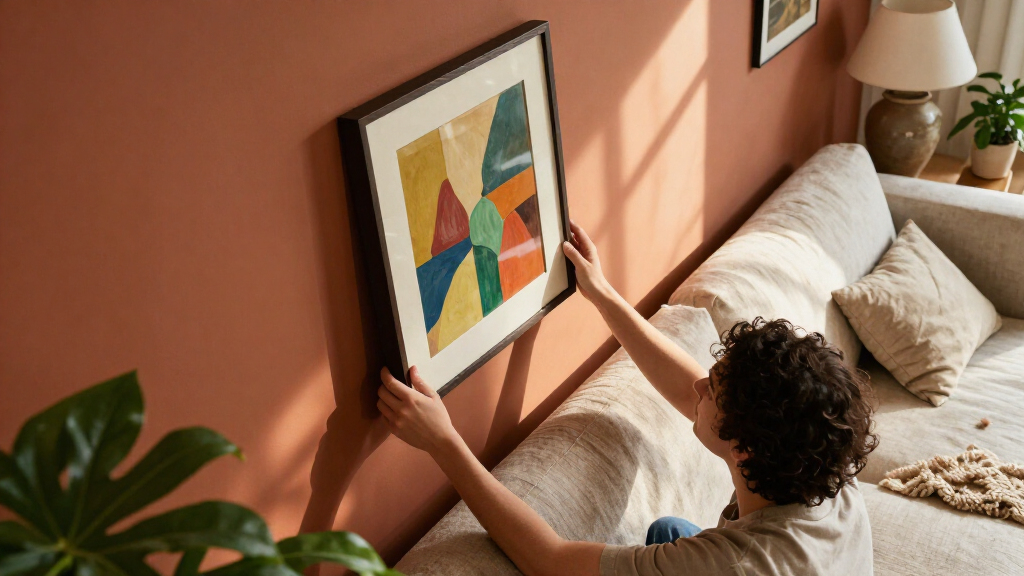
The report also discusses how visual qualities may influence mood. Jones says some clients feel calmer around abstract works with rounded shapes and softer lines. Hodge similarly describes soft colors, smooth lines, circles and horizontal compositions as calming for some viewers. By contrast, she says bold colors, sharp angles and jagged lines may feel energizing to one person and unsettling to another.
Choosing Art for a Room’s Mood
The experts’ comments offer a practical way to think about artwork as part of a room’s atmosphere, rather than as decoration chosen only to match furniture. Someone furnishing a bedroom might seek images and colors they personally find restful, while a shared dining space could call for work that feels livelier to its occupants. Art can also introduce color in a smaller, changeable way than paint or wallpaper.
The advice is not a substitute for individual judgment. The report stresses that a picture can evoke memories or associations that its owner did not intend, and a color considered soothing by one person may not have that effect on another. For readers, the useful takeaway is to notice their own response before choosing a piece for a room they use every day.
Products Worth Considering

Philips Hue Smart LED Candle Bulbs, B39, E12, White and Color Ambiance, 2-Pack

LEVOIT Air Purifier for Home, Pets, Bedroom, Smart WiFi

Philips Hue White and Color Ambiance Smart Light Starter Kit, 2 A19 Bulbs with Hub
As an affiliate, we earn on qualifying purchases.
Personal Experience Shapes Interpretation
The report places the discussion within a broader view of art as subjective: viewers bring their memories and experiences to what they see. Hodge says the same painting can prompt very different reactions. Jones also describes that subjectivity as both a creative opportunity and a challenge when designing a home around a client’s preferences.
Veranda uses artists including Agnes Martin, Henri Matisse and Mark Rothko as examples of art associated with color and emotion. Hodge says Martin sought to use a blue color block to encourage calm, and recounts Matisse’s belief that colors could affect viewers. Rothko, she says, aimed to express basic human emotions and noted that some viewers cried in response to his paintings. These examples describe artists’ intentions and reported reactions; they do not establish a universal emotional effect.
The report also mentions Andy Warhol’s Campbell’s soup imagery as an example of finding inspiration in everyday subjects. Hodge says Warhol connected the image to something familiar and accessible. The source material provided ends during this discussion, so it does not include the report’s full account of the example.
“When we see art that we find pleasing, it gives us a dopamine rush.”
— Susie Hodge, art historian, artist and author of How Art Can Change Your Life
No Universal Mood Formula
The report does not establish that specific colors or shapes reliably cause particular emotional or physical changes. It presents expert observations and examples, while acknowledging that a person’s memories and preferences can alter their response. Hodge’s comments about dopamine and Matisse’s reference to blood pressure are not accompanied in the supplied material by research methods, data or medical evidence.
It is also unclear how the advice might vary across cultures, individuals or different kinds of artwork. The source material supplied for this article cuts off partway through its discussion of Warhol, and does not provide the report’s complete ending or publication date.
Test Responses in Your Own Home
The report offers no announced follow-up study or policy change. Its practical implication is to treat expert suggestions as starting points: consider how a piece feels in the room where it will hang, and whether that response fits how the space is used. Since the source does not claim a universal formula, the next step for homeowners is personal observation rather than relying on a color rule alone.
Key Questions
Can art affect how people feel at home?
It may influence mood, according to the experts quoted by Veranda, but responses differ. Personal memories, preferences and the artwork itself all matter.
Which colors do the experts associate with calm?
Decorator Cameron Jones mentions greens, blues and muted neutrals as possible choices for a calm bedroom. The report presents these as design suggestions, not guaranteed effects.
Does abstract art make people feel calmer?
Jones says some clients feel calmer around abstract works with rounded shapes and softer lines. The report also notes that different viewers can react differently to the same work.
Should I choose art based on a room’s purpose?
Jones says she asks clients how they want a room to feel and uses that as one guide. Readers can consider a room’s purpose alongside their own personal response to a piece.
Source: veranda.com