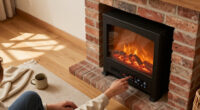
When comparing electric fireplace heaters, the real choice is often between an electric fireplace insert and a freestanding electric fireplace. Both can add a flame effect and supplemental heat without burning wood or requiring a vent, but they solve different room problems. An insert is designed to sit inside a compatible fireplace opening or enclosure, where it can look like part of the room. A freestanding model needs only a suitable floor location and outlet, making it simpler to set up and easier to move.

Get furniture and decor delivered free with Prime
- Fast, free delivery on millions of items
- Prime Video, Amazon Music and more included
- Member-only deals all year

duraflame Freestanding Electric Fireplace Stove Heater with 3D Flame Effect for 1,000 Sq. Ft. Room, Black
- ✔ Heat output: 5,200 BTU
- ✔ Listed coverage: Up to 1,000 sq. ft.
- ✔ Power: 1,500W

Silonn Electric Fireplace Heater, Quick Heating Portable Fireplace with App & Remote, 24″ Electric Corner Fireplace Low Noise wit…
- ✔ Power: 1,400W
- ✔ Heat output: 5,300 BTU
- ✔ Temperature range: 62°F to 82°F

Electric Fireplace Heater Stove with 3D Flame, 1000/1500W & Flame-Only Mode
- ✔ Heat output: Up to 5,100 BTU
- ✔ Heat settings: 1,000W and 1,500W
- ✔ Dimensions: 15.35 in. W × 9.45 in. D × 22.28 in. H
The biggest tradeoff is room integration versus flexibility. Choose an insert if you already have a fireplace opening and want a more built-in appearance. Choose a freestanding heater if you rent, want to avoid enclosure work, or may rearrange the room. In either case, check the product’s heating output, dimensions, electrical requirements, and manufacturer guidance before buying; the flame display can make a room feel cozier, but it does not replace a home’s primary heating system.
At a Glance
| Criteria | Electric fireplace inserts | Freestanding electric fireplace heaters | Winner |
|---|---|---|---|
| Installation | Must fit a fireplace opening or prepared enclosure; some models require fitting work | Usually place on a stable surface and plug in, subject to model instructions | B |
| Appearance | More integrated, especially in an existing fireplace | Visible appliance or furniture-style unit | A |
| Portability | Low once installed | Higher; can be moved when cool and disconnected | B |
| Heating use | Supplemental heat; output varies by model | Supplemental heat; output varies by model | Depends |
| Room compatibility | Best where a compatible opening exists | Works in more rooms if space and a suitable outlet are available | B |
| Upfront cost and value | Can be good value when reusing an existing fireplace; enclosure work can add cost | Often avoids installation costs, though larger or furniture-style units may cost more | Depends |
| Maintenance | Generally light routine care; keep vents clear and follow product instructions | Generally light routine care; keep vents clear and follow product instructions | Tie |
duraflame Freestanding Electric Fireplace Stove Heater with 3D Flame Effect for 1,000 Sq. Ft. Room, Black
The Duraflame is the most balanced choice here for shoppers who want a freestanding heater to look like a small wood stove. Its side viewing windows, opening glass door, and brick-style back panel give the unit more traditional character than the modern corner design of the Silonn. More practically, the listing specifies 5,200 BTU and coverage of up to 1,000 square feet, giving buyers a reference point the other two listings do not provide. That coverage is a product claim, not a promise that every room of that size will feel evenly warm.Independent flame and heat controls make this model useful across seasons: we can keep the 3D flame and glowing logs on for atmosphere without running the heater. An adjustable thermostat and flame dial offer a direct way to change comfort and brightness, while the included remote adds convenience. Compared with the Silonn, however, the Duraflame listing does not describe app controls, a timer, a child lock, or tilt shutdown. And while it is portable, its traditional stove shape takes more visual and floor space than the ZAFRO’s stated 15.35-inch width.This is our lead recommendation for buyers who value stove styling and stated room coverage as much as the flame effect. We would look elsewhere if app-based control, a specified timer, or compact dimensions are the deciding factors. Its 1,500W consumption also makes it a substantial plug-in appliance, so we should plan its use as supplemental room heating rather than expect it to replace a home’s central system.
Pros:
- Stated heating coverage of up to 1,000 square feet
- Independent heat and flame controls for year-round use
- Traditional details include side windows, an opening glass door, and brick-style backing
- Remote control and adjustable thermostat are included
Cons:
- Its 1,500W draw calls for planning around available electrical capacity and supplemental use
- The listing does not specify app control, a timer, child lock, or tilt shutdown
- The broad coverage figure is not a guarantee of even warmth in every room
Best for: Buyers who want traditional stove styling, independent flame and heat controls, a remote, and a published coverage figure for supplemental heating.
Not ideal for: Shoppers who need app control, a listed timer or child lock, or the smallest possible freestanding footprint.
Bottom line: We recommend the Duraflame as the most balanced stove-style heater here for buyers who value independent controls and clearly stated coverage.
“We recommend the Duraflame as the most balanced stove-style heater here for buyers who value independent controls and clearly stated coverage.”
Silonn Electric Fireplace Heater, Quick Heating Portable Fireplace with App & Remote, 24″ Electric Corner Fireplace Low Noise wit…
The Silonn makes the strongest case for buyers who want to adjust a fireplace heater without walking over to it. Its app and remote controls handle temperature, flame brightness, and operation, while a one-to-eight-hour timer lets us set a defined run period. The display offers five brightness levels and a stated temperature range of 62°F to 82°F, a more explicit set of adjustment details than the Duraflame listing provides. At a stated 37 dB, it is also positioned for quieter use in a living room or bedroom.Its 24-inch corner format creates a different fit from the two upright stoves. We would consider it where a corner placement and modern square shape suit the room better than the ZAFRO’s narrow, vintage-style body. Safety details are a notable part of its pitch: the listing specifies overheat protection, a child lock, and automatic shutdown if the unit tilts more than 45 degrees. That is a more detailed safety feature list than the other products provide, though buyers should still follow the manufacturer’s instructions for placement and operation.The tradeoff is that the supplied details list 1,400W and 5,300 BTU but do not state square-foot coverage, making room-to-room comparison less straightforward than with the Duraflame. The app also adds a setup and connectivity step that buyers seeking simple physical controls may not want. Choose Silonn for remote flexibility and scheduling; skip it if a traditional stove look or a published coverage figure matters more.
Pros:
- App and remote control for settings and operation
- One-to-eight-hour timer and five flame brightness levels
- Temperature control listed from 62°F to 82°F
- Overheat protection, child lock, and tilt-triggered shutdown are specified
Cons:
- No square-foot heating coverage is provided in the supplied details
- App operation may require setup and connectivity that some buyers do not need
- Corner form and 24-inch size may not suit every room layout
Best for: Buyers who want app and remote operation, scheduled run time, multiple flame brightness levels, and a corner-oriented modern design.
Not ideal for: Shoppers who prefer simple controls, need a stated square-foot coverage figure, or specifically want a traditional stove silhouette.
Bottom line: We favor the Silonn when app control, a timer, and its specified safety features matter more than a published room-coverage figure.
“We favor the Silonn when app control, a timer, and its specified safety features matter more than a published room-coverage figure.”
Electric Fireplace Heater Stove with 3D Flame, 1000/1500W & Flame-Only Mode
The ZAFRO is the compact pick for buyers who want the familiar freestanding stove shape without committing to the larger presence of a corner fireplace. Its listed dimensions are 15.35 inches wide, 9.45 inches deep, and 22.28 inches tall, so we can judge its footprint before choosing a spot. The narrow body contrasts with the Duraflame’s more elaborate side windows and opening door; the ZAFRO instead emphasizes portability and an easy-to-clean smooth exterior.Two heat settings, 1,000W and 1,500W, give us a basic way to adjust output, and the listing states up to 5,100 BTU. The 3D flame has adjustable brightness and independent flame-only operation, which makes it usable for ambiance beyond the heating season. Compared with the Silonn, though, the ZAFRO’s supplied details do not mention app access, a timer, child lock, or a temperature range. Its safety information specifies overheat protection and outwardly expanding feet intended to improve stability, but the listing does not provide the Silonn’s tilt shutdown detail.This is the right fit when small dimensions and uncomplicated heat levels outweigh advanced scheduling. The product description claims warmth in three to five minutes, but we would treat that as a listing claim rather than a room-wide heating guarantee. Its maker’s warranty details are not specified in the supplied information, and it lacks the Duraflame’s stated square-foot coverage. Buyers comparing expected room performance should account for those gaps before choosing it over the higher-ranked models.
Pros:
- Compact listed dimensions for a freestanding stove
- Two heat settings: 1,000W and 1,500W
- Adjustable 3D flame brightness with flame-only operation
- Overheat protection and widened feet are specified
Cons:
- No square-foot heating coverage is listed
- Supplied details do not specify a timer, app control, or child lock
- Warranty duration is not given in the supplied information
Best for: Buyers seeking a compact vintage-style electric stove with two wattage settings and a flame-only mode.
Not ideal for: Shoppers who need app control, a timer, a published coverage area, or fuller warranty details before deciding.
Bottom line: We would choose the ZAFRO for its compact stove footprint and basic two-level heating, while recognizing that its coverage and control details are limited.
“We would choose the ZAFRO for its compact stove footprint and basic two-level heating, while recognizing that its coverage and control details are limited.”
As an Amazon Associate we earn from qualifying purchases.
Key Differences
The clearest difference is how each heater occupies the room. An insert uses an existing fireplace opening or a prepared enclosure, which can make the flame effect feel like a permanent feature. That can be worth the fitting effort if the opening is usable and the style suits the home. A freestanding model is less tied to the room: set it in an appropriate location, connect it as directed, and it can be repositioned later. That convenience makes it a more practical choice for renters and people who expect to move.
Neither format automatically heats better. Actual performance depends on the specific heater, the room, insulation, and how heat circulates. Compare published output and coverage claims for the individual models rather than assuming an insert or freestanding design has an advantage. Both are best treated as supplemental heaters, with flame effects that may operate separately on some models. Value follows the same practical divide: an insert can make sense when it uses a fireplace opening you already have, while a freestanding unit can save money and hassle when fitting an enclosure would be necessary.
Detailed Comparison
Installation (Freestanding electric fireplace heaters wins — major)
A freestanding heater wins for straightforward setup: it generally needs a suitable location and outlet, with clearances and use governed by its manual. An insert must match the opening or enclosure, so measuring and fitting matter. The difference is moderate for someone with an existing compatible fireplace, but major if the opening needs alteration. In practice, choose freestanding for the least involved setup; choose an insert when the room is already prepared for one.
Appearance (Electric fireplace inserts wins — moderate)
An insert wins when a built-in look is the priority. Set into a fireplace opening, it can appear more integrated than a standalone appliance. Freestanding models can still be attractive, including mantel-style designs, but remain visible as separate units. The gap is moderate and depends on the room: an existing fireplace favors the insert, while a flexible furniture layout may suit a freestanding model.
Portability (Freestanding electric fireplace heaters wins — major)
Freestanding models clearly win because they can usually be moved after they have cooled and been disconnected according to the manual. An insert is intended to stay in place and may require effort to remove. This is a major difference for renters, seasonal use, or households that rearrange rooms. Pay for an insert’s integrated look only if you expect to keep it in that location.
Heating use (moderate difference)
Neither category wins across the board. Both provide supplemental electric heat, and the useful warmth depends on the model’s output and the room’s size and heat loss. A flame effect is a visual feature, not a reliable sign of greater heating capacity. The difference is minor at the category level but could be substantial between individual models. Compare specifications and intended room coverage, and do not assume either heater will replace central heat.
Room compatibility (Freestanding electric fireplace heaters wins — major)
Freestanding heaters win because they can serve rooms without fireplace openings, provided there is enough suitable floor space and the required electrical setup. Inserts are limited to compatible openings or enclosures. This is a major practical difference in apartments, bedrooms, and homes without a fireplace. An insert becomes compelling when the opening is already present and correctly sized.
Upfront cost and value (moderate difference)
There is no universal price winner. A freestanding unit can avoid fitting expenses, which makes it better value when there is no ready-made fireplace opening. An insert may offer more value if it uses an existing opening and the buyer wants the permanent look. Costs vary by model and any required enclosure work. Pay more for an insert when room integration matters and fitting remains simple; otherwise, the extra work may not improve daily use enough to justify it.
Maintenance (minor difference)
This is essentially a tie. Both types avoid ash and chimney cleaning associated with wood fires, but they still need ordinary care such as keeping air openings clear and cleaning surfaces as directed. Follow the manufacturer’s instructions for inspection, placement, and use. For most buyers, maintenance should be a minor factor compared with fit, installation, and portability.
Electric fireplace inserts: Pros and Cons
Pros:
- Can create a more integrated fireplace appearance
- Makes practical use of a compatible existing opening
- Can be a strong choice for a fixed living-room feature
Cons:
- Requires a suitable opening or enclosure
- Less portable after installation
- Fitting needs can add cost and effort
Freestanding electric fireplace heaters: Pros and Cons
Pros:
- Usually simpler to place and set up
- Works in rooms without a fireplace opening
- Can be moved if the room layout or home changes
Cons:
- Remains a separate visible unit
- Uses floor space
- May feel less integrated than an insert
Who Should Choose What
Choose Electric fireplace inserts if:
- You have a compatible fireplace opening and want an integrated appearance.
- You are furnishing a long-term home and expect the heater to stay in one place.
- You value a fireplace focal point more than portability.
Choose Freestanding electric fireplace heaters if:
- You want to avoid fitting an insert or altering an enclosure.
- You rent, expect to move, or may rearrange the room.
- You need supplemental heat and a flame effect in a room without a fireplace.
Skip both if: You need a primary heating system, or neither format fits your room, electrical setup, or heating requirements.
Value for Money
Paying more for an insert is worthwhile when a compatible opening is already available and the built-in appearance matters to you. In that situation, the additional spend can buy a feature that suits the room rather than a heater that looks temporary. If the opening needs substantial fitting, add that cost to the comparison before deciding; the insert’s appearance may not justify the extra work for a buyer who mainly wants warmth.
A freestanding heater is often the better value for flexible use because it can avoid installation work and adapt to different layouts. That does not mean every freestanding unit is inexpensive: mantel-style designs and larger models may cost more. Compare the total cost, including fitting where relevant, against the features you will actually use. For either type, choose based on room compatibility and supplemental heating needs rather than a flame effect alone.
Final Verdict
For most buyers without an existing fireplace opening, a freestanding electric fireplace heater is the more practical choice: setup is simpler, room compatibility is broader, and the unit can move with the household. Choose an insert when you already have a compatible opening, want a more integrated focal point, and expect the heater to stay there. The deciding factor is whether the built-in appearance is worth giving up flexibility and potentially paying for fitting. If you need whole-home heating, skip both as a primary solution and look for a heater designed for that job.
Frequently Asked Questions
Which is easier to install, an insert or a freestanding electric fireplace?
A freestanding unit is usually easier to place because it does not need to fit a fireplace opening. An insert must match a compatible opening or enclosure, and some installations require fitting work. Follow the manual for clearances and electrical requirements either way.
Does an electric fireplace insert heat better than a freestanding heater?
Not by category alone. Heating performance depends on the specific model and the room. Compare the published output and coverage information for the heaters you are considering, and treat either type as supplemental heat unless the manufacturer specifies otherwise.
Is an insert worth paying more for?
It can be if you have a compatible opening and value the integrated appearance. If fitting adds substantial cost or you may move the heater, a freestanding model may deliver better value for your needs.
Can you move a freestanding electric fireplace?
Many freestanding models can be moved when cool and disconnected, following the manufacturer’s instructions. Inserts are designed to stay in place and are less convenient to relocate.
Can either type replace central heating?
These products are generally used for supplemental heat and ambience. Check the model’s specifications against your room and heating needs; do not assume an electric fireplace heater can heat an entire home.