To spot mid-century modern knock-offs, examine the craftsmanship, hardware, and finishes. Authentic pieces have tight joints, smooth finishes, and natural wood grains, while fakes often show rough edges, lightweight construction, or uniform patterns. Look for genuine hardware, subtle design details, and authenticity markings like stamps or signatures. If you pay close attention to these clues, you’ll be better equipped to tell real mid-century modern furniture from imitations—and there’s more to discover if you keep exploring.

Get furniture and decor delivered free — and shop member deals
- Fast, free delivery on millions of items
- Access to Prime Big Deal Days deals on October 6–7
- Prime Video, Amazon Music and more included
Key Takeaways
- Examine construction details; real pieces have tight joints, smooth finishes, and solid feel, while knock-offs often have rough edges.
- Check for authentic hardware and markings; genuine items may have designer stamps or period-appropriate hardware, unlike cheap imitators.
- Observe the finish and wood grain; authentic furniture displays natural variations, whereas fakes often have uniform, glossy surfaces.
- Assess proportions and design details; real mid-century pieces feature tapered legs and precise angles, while copies may be exaggerated or off.
- Look for material quality and pattern variations; authentic furniture uses high-quality, naturally varied wood, unlike mass-produced, uniform-looking imitations.
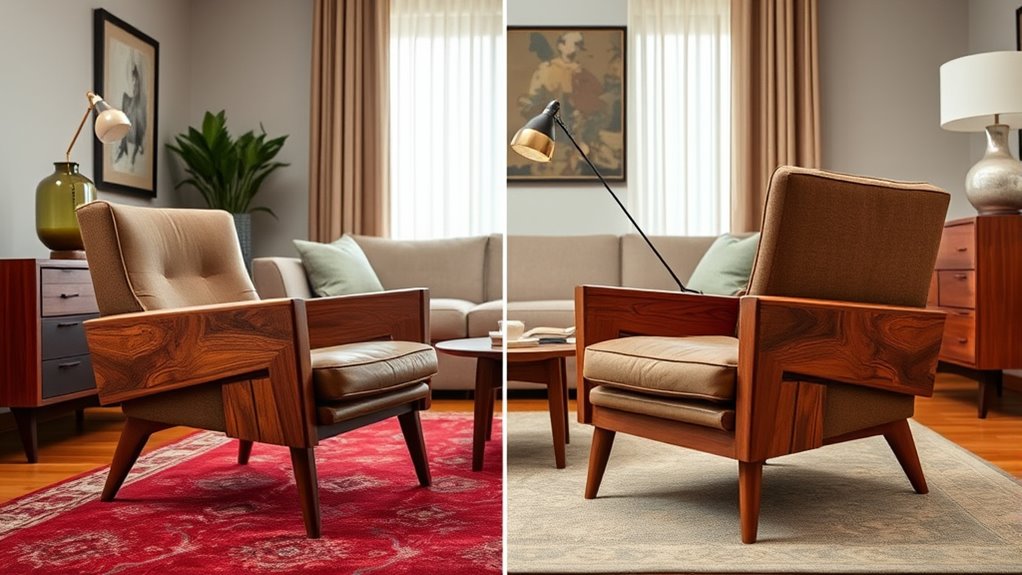
Mid-century modern furniture remains a popular style, but with its surge in demand, knock-offs and imitations have also flooded the market. It’s easy to get caught up in the allure of sleek lines and minimalist appeal, but recognizing a genuine piece versus a counterfeit takes some knowledge. One of the most reliable ways to tell is by examining the craftsmanship qualities. Authentic mid-century modern furniture is known for its meticulous construction, smooth finishes, and sturdy feel. Look closely at the joints and seams—real pieces will have tight, seamless connections without gaps or rough edges. The wood should feel solid and substantial, not lightweight or flimsy, which can be a giveaway of cheaper, imitation materials.
Authentic mid-century modern furniture features meticulous construction, seamless joints, and solid, high-quality materials.
In addition to craftsmanship, authenticity identifiers are *vital*. Original mid-century modern furniture often has labels, stamps, or signatures from the designer or manufacturer. These can sometimes be found on the underside of a piece or discreetly embedded within the construction. If a piece claims to be authentic but lacks any markings, it’s worth scrutinizing further. Pay attention to the details like hardware—original pieces often feature high-quality, well-made hardware that’s appropriate for the period, such as brass or chrome fittings, rather than cheap plastic or poorly finished metals.
Colors and finishes can also reveal authenticity. Genuine mid-century modern furniture typically showcases natural wood grains and finishes that highlight the material’s character. If the finish looks overly glossy, plastic-like, or appears to be a thin veneer with visible seams, it could be a fake. Veneer is common in authentic pieces, but it should be applied smoothly and evenly, with no bubbling or peeling. Also, be wary of overly uniform colors or patterns—authentic furniture often displays subtle variations in wood tone that are impossible to replicate in mass-produced counterfeits. Moreover, understanding wood grain patterns can help distinguish authentic pieces from imitations since genuine furniture often exhibits natural, unique variations.
Another key aspect is the design itself. While knock-offs often mimic the overall silhouette, they tend to lack the nuanced details that define authentic mid-century modern furniture. For example, authentic pieces often feature tapered legs, precise angles, and balanced proportions. If the design feels off or the proportions are exaggerated or inconsistent, it’s a red flag.
authentic mid-century modern furniture
As an affiliate, we earn on qualifying purchases.
As an affiliate, we earn on qualifying purchases.
Frequently Asked Questions
How Can I Identify Authentic Mid-Century Modern Designer Signatures?
You can identify authentic mid-century modern designer signatures by examining craftsmanship details and signature placement. Look closely at the craftsmanship—authentic pieces often have precise joints and smooth finishes. Check the signature’s location; genuine designer signatures are typically stamped or etched in specific spots, like underneath or on the back. Familiarize yourself with the designer’s known signature style and placement to confidently distinguish real deals from imitations.
Are Price Differences Reliable Indicators of Authenticity?
Price variation can hint at authenticity, but it’s not foolproof. Generally, if a piece is notably cheaper than similar items, it might be a knock-off or damaged. You should also consider seller credibility—reputable dealers with good reviews and transparent histories are more likely to sell genuine mid-century modern furniture. Don’t rely solely on price; verify signatures, craftsmanship, and provenance to confirm you’re getting an authentic piece.
What Materials Are Typically Used in Original Mid-Century Furniture?
Original mid-century furniture often features high-quality wood veneers, giving a sleek, smooth finish without using solid wood everywhere. You’ll also see molded plastics, which designers used to create innovative shapes and vibrant colors. Keep an eye out for these materials, as authentic pieces typically incorporate them with craftsmanship and attention to detail. Knock-offs might use cheaper, less durable alternatives or lack the fine veneer work found in genuine mid-century designs.
How Do Vintage Wear and Tear Affect Authenticity Assessments?
Vintage wear and tear act like whispers from the past, revealing patina authenticity and vintage distress that authentic mid-century furniture bears. These signs of use add a layered story, making the piece feel alive with history. If the wear looks natural and consistent, it confirms genuine age. However, overly uniform or artificially distressed surfaces can signal a fake, so you should look for authentic aging clues that tell a true story of time’s passage.
Can Reproduction Furniture Have Valuable Vintage Components?
Reproduction furniture can indeed feature vintage components that add value, especially if crafted with authentic craftsmanship. You should look for genuine vintage parts, like hardware or wood, which can boost the piece’s worth. Even if the overall reproduction isn’t original, incorporating vintage components enhances its appeal and value. Keep in mind, the quality of reproduction craftsmanship directly impacts whether these vintage elements are truly valuable or just decorative fakes.
mid-century modern furniture hardware
As an affiliate, we earn on qualifying purchases.
As an affiliate, we earn on qualifying purchases.
Conclusion
Now that you know the telltale signs, trust your instincts and do a little extra digging. Some might say that authentic mid-century modern pieces are timeless, but history shows that imitation often floods the market, diluting the style’s integrity. By examining details and verifying origins, you can confidently distinguish real deals from knock-offs. After all, embracing authenticity not only preserves the design’s true spirit but also guarantees your space remains uniquely yours.
mid-century modern wood grain furniture
As an affiliate, we earn on qualifying purchases.
As an affiliate, we earn on qualifying purchases.
mid-century modern furniture labels
As an affiliate, we earn on qualifying purchases.
As an affiliate, we earn on qualifying purchases.
Fall Picks
fall essentials
As an affiliate, we earn on qualifying purchases.