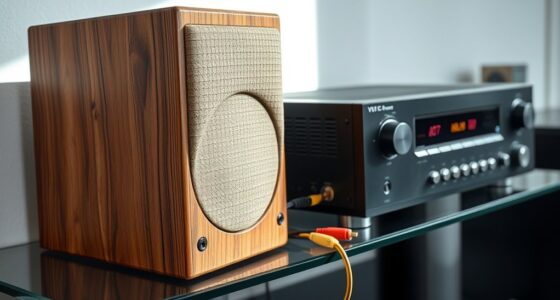
Exploring mono versus stereo recordings shows how your listening has shifted from simple, single-channel sound to immersive, multidimensional audio experiences. Mono offers a focused, straightforward sound that works well across various systems, while stereo creates a sense of space with instrument and vocal placement, enhancing realism. This evolution means you can now enjoy richer, more dynamic music or stick to pure clarity—continue exploring to discover how these formats shape what you hear.
Key Takeaways
- Listening has shifted from mono’s straightforward sound to stereo’s immersive spatial experience.
- Modern technology enhances stereo playback, creating more realistic and dynamic listening environments.
- Mono recordings offer clarity and authenticity, appealing to audiophiles and vintage sound enthusiasts.
- The choice between mono and stereo influences how listeners perceive instrument placement and depth.
- Understanding these formats helps optimize listening based on preferences for realism, fidelity, or simplicity.

When choosing between mono and stereo recordings, understanding their differences can considerably influence your listening experience. Mono, short for monophonic sound, uses a single channel to deliver audio, meaning all sound sources are mixed into one track. Stereo, on the other hand, employs two or more channels, creating a sense of space and dimension. This distinction directly impacts audio fidelity, which is the accuracy and clarity of the sound you perceive. With stereo recordings, you often get a richer, more immersive experience because sounds can be positioned across the left and right channels, mimicking real-life hearing. Conversely, mono recordings tend to have a more uniform sound, which can sometimes feel flat or less detailed but can also offer a purer, uncolored listening experience in certain contexts.
Mono delivers a focused, uniform sound, while stereo creates a rich, immersive listening experience through spatial separation.
Your listener experience varies notably depending on the recording type. Stereo recordings can make you feel as if you’re inside the music, with instruments and vocals placed around you, creating a dynamic and engaging atmosphere. This spatial element is especially noticeable with headphones or high-quality speakers, where the separation of channels enhances depth and realism. However, stereo isn’t always ideal, particularly in environments with poor acoustics or when listening to certain older recordings. Sometimes, stereo mixes can introduce phase issues or muddiness, which might diminish audio fidelity rather than improve it. Mono recordings, meanwhile, offer a straightforward, focused sound that can be more consistent across different playback systems. They also preserve the core essence of the original performance, making them preferable in situations where clarity and fidelity are paramount.
Historically, mono recordings were the standard, and many classic albums and broadcasts still retain their original mono mixes. These recordings can provide a nostalgic or authentic listening experience, especially for fans of vintage sound. Modern technology, however, has shifted the focus toward stereo and multi-channel formats, prioritizing spatial awareness and realism. Yet, some audiophiles argue that mono can sometimes deliver higher audio fidelity because it eliminates phase cancellations and other artifacts that may occur in stereo mixes. This can make mono recordings sound more direct and uncolored, which appeals to those seeking purity in sound. Additionally, advancements in audio technology have made it possible to enhance mono recordings without losing their original character.
Ultimately, your choice between mono and stereo depends on your preferences and the listening context. Stereo offers a more immersive and dynamic experience, ideal for enjoying the full breadth of a recording. Mono, meanwhile, can deliver clarity, authenticity, and a focus that some listeners find more satisfying. Recognizing these differences helps you make better decisions about what to listen to, ensuring your audio experience aligns with what you value most—whether it’s spatial realism or straightforward fidelity.
Top picks for "explor mono stereo"
Open Amazon search results for this keyword.
As an affiliate, we earn on qualifying purchases.
Frequently Asked Questions
How Do Mono and Stereo Recordings Affect Music Mixing Techniques?
Mono and stereo recordings influence your mixing techniques by emphasizing mono compatibility and stereo imaging. You need to guarantee elements sound good on mono devices, so avoid phase issues that cause loss of clarity. For stereo, you focus on balancing the stereo image, creating a sense of space and depth. Your mixing process adjusts panning, levels, and effects to optimize both mono compatibility and stereo imaging for a seamless listening experience.
What Are the Best Genres for Mono Versus Stereo Recordings?
If you’re into vintage jazz, mono recordings often deliver classic warmth and a cohesive sound, emphasizing the ensemble’s unity. For classical music, stereo recordings excel with their spatial accuracy, capturing intricate details and creating an immersive experience. Your choice depends on the genre’s needs; mono suits vintage jazz’s vintage charm, while stereo enhances the classical experience with superior spatial realism and accuracy.
Can Mono Recordings Be Upgraded to Stereo Without Losing Quality?
Did you know that over 70% of classic recordings were originally mono? You can upgrade mono recordings to stereo using restoration techniques, but it’s tricky. You need specialized equipment compatibility to avoid losing quality. While some enhancements are possible, they often don’t match the authentic depth of true stereo. So, consider whether the upgrade preserves the original sound or diminishes its historical charm.
How Does Listener Perception Differ Between Mono and Stereo Formats?
You perceive mono recordings as a centered, uniform sound, which limits your spatial awareness and sound localization. In contrast, stereo formats create a sense of depth and direction, making it easier for you to identify where sounds originate. This difference enhances your listening experience, allowing you to feel more immersed and aware of the sound environment, ultimately enriching how you interpret and enjoy music or audio content.
Are There Specific Listening Environments Optimized for Mono or Stereo?
You might find that a dedicated stereo setup thrives in a room with strategic speaker placement and acoustic treatment, creating an immersive experience. Conversely, mono recordings excel in environments where speaker placement is less critical, like portable speakers or noisy spaces. To truly enjoy each format, optimize your environment accordingly—enhance speaker placement, reduce reflections, and control acoustics—transforming your listening into a mesmerizing journey, no matter where you are.
Conclusion
As you dive deeper into the world of recordings, one thing becomes clear: the choice between mono and stereo isn’t just technical — it’s emotional. Will you embrace the vintage charm of mono or the immersive depth of stereo? The journey of listening is evolving, and with every track, you’re invited to discover what truly moves you. So, what will your next listen reveal? The story’s only just beginning.