
To set up a subwoofer in your vintage audio system, start by placing it a few feet away from walls and away from corners for clear, balanced bass. Connect it using quality cables to the receiver’s dedicated output or line-level input. Adjust the crossover to around 80 Hz and experiment with placement and phase settings to blend smoothly with your main speakers. Fine-tuning these details helps improve sound quality—continue to explore for more tips.
Key Takeaways
- Position the subwoofer a few feet from walls and away from corners for balanced bass in a vintage system.
- Connect the subwoofer using high-quality cables to the dedicated line-level or speaker outputs of your receiver.
- Set the crossover around 80 Hz, adjusting slightly to blend smoothly with your vintage main speakers.
- Use the phase switch (0 or 180°) to align the sub’s bass with the main speakers and prevent cancellation.
- Fine-tune placement and crossover settings through listening tests to achieve clear, punchy bass without muddiness.
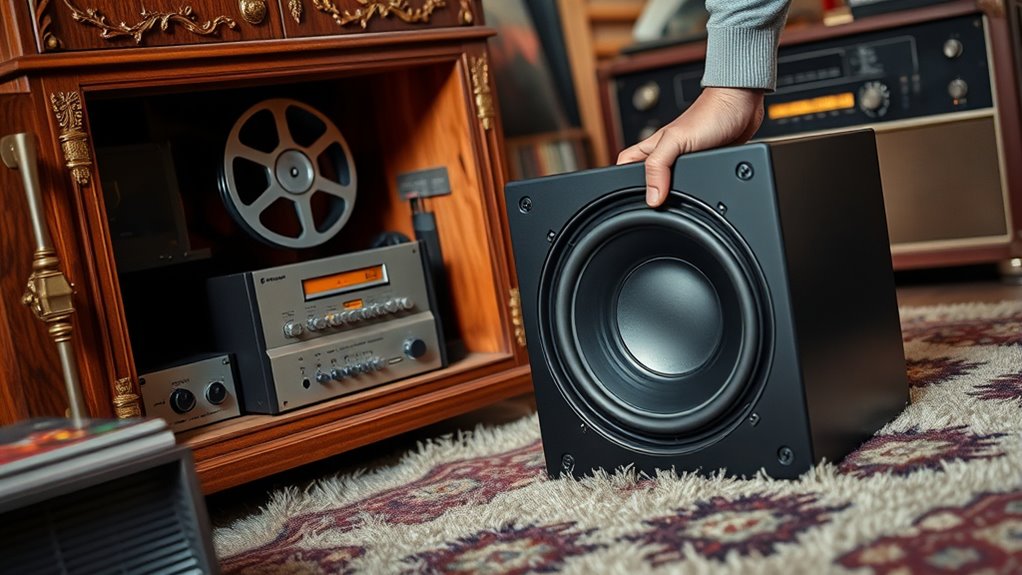
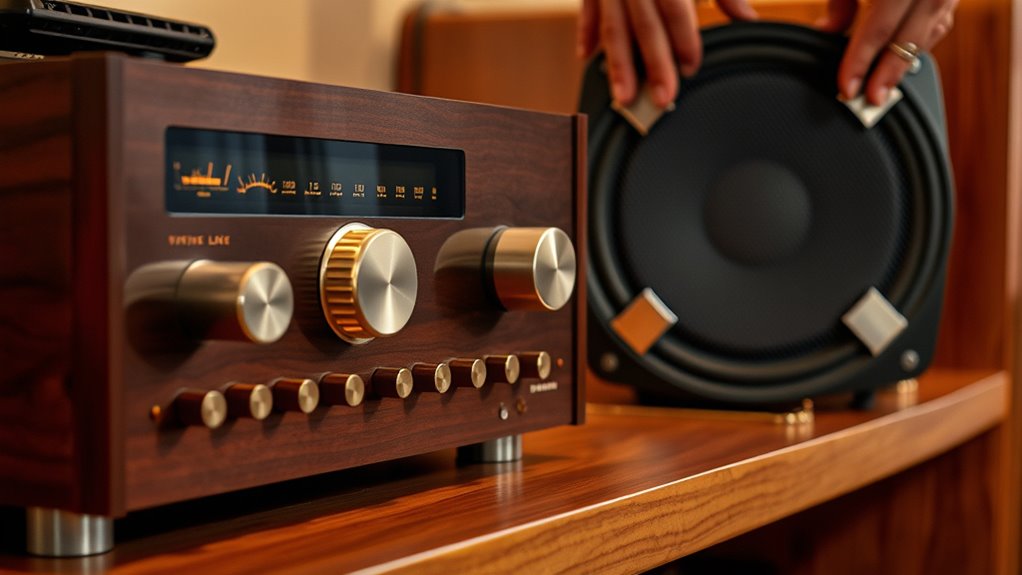
Setting up a subwoofer might seem straightforward, but proper placement and connection are vital to get the best sound quality. When it comes to placement options, where you position your subwoofer can considerably influence how deep and powerful your bass sounds. You want to avoid placing it directly against walls or in corners, which can cause exaggerated bass and muddy the overall sound. Instead, try placing the subwoofer a few feet away from walls, preferably near the front of your listening area, so the bass feels balanced and tight. Experiment with different spots to find the position that delivers the clearest, most punchy bass without overwhelming the other sounds.
Once you’ve settled on a good spot, focus on the crossover settings. These settings determine how your subwoofer blends with your vintage audio system’s main speakers. If the crossover is set too high, the sub may interfere with the lower frequencies of your regular speakers, creating a muddy or boomy sound. Conversely, if it’s too low, the sub won’t produce enough bass impact. Start with the crossover set around 80 Hz, which is a common frequency for blending subwoofers with most speakers, and then adjust based on what sounds best in your space. Some subwoofers and vintage systems allow you to fine-tune this setting, so experiment with a few different levels to find the optimal spot where the bass integrates seamlessly with your system’s other frequencies.
Connecting your subwoofer properly is just as vital as placement and crossover settings. Use quality speaker cables to connect the sub to your amplifier or receiver, ensuring solid, secure connections that won’t introduce noise or interruptions. If your vintage system has a dedicated subwoofer output, use that for a cleaner signal. If not, you might need to use a line-level input or a speaker-level connection, depending on your equipment. Make sure that your amplifier or receiver’s bass management is configured to send the appropriate signals to the subwoofer, and check that the phase switch on your subwoofer is set correctly — usually 0 or 180 degrees — to ensure the sound waves align properly with your main speakers, preventing phase cancellation and maximizing bass response. Additionally, understanding how frequency response affects your system can help you fine-tune the overall sound for optimal clarity and depth.
Frequently Asked Questions
Can I Add a Subwoofer to a Vintage Receiver Without Modern Upgrades?
Yes, you can add a subwoofer to a vintage receiver without modern upgrades. Make sure your vintage system’s compatibility by checking if it has preamp or line-level outputs for easy connection. Use appropriate speaker placement to optimize sound quality and avoid distortion. You might need a simple subwoofer amplifier or a speaker-level input converter. With careful setup, your vintage system can deliver improved bass without sacrificing its classic charm.
What Are the Best Subwoofer Models Compatible With Vintage Audio Systems?
You should consider subwoofers like the SVS SB-1000 or the Klipsch R-120SW, which offer compatibility with vintage systems through adjustable crossover settings. While placement is key, guarantee it’s near your main speakers for seamless sound integration. These models balance power and finesse, fitting well without modern upgrades, and let you fine-tune your vintage setup to deliver deep bass without overwhelming your classic components.
How Do I Match the Subwoofer’s Impedance With My Vintage Amp?
To match your subwoofer’s impedance with your vintage amp, start by checking the speaker compatibility specs on both. Impedance matching is essential to prevent damage and guarantee ideal sound. If your amp supports 8 ohms, choose a subwoofer with the same impedance. Use a multimeter or consult the manuals if needed. Proper impedance matching guarantees your vintage system performs smoothly and sounds great.
Is It Possible to Connect a Powered Subwoofer Directly to a Vintage Receiver?
Think of connecting a powered subwoofer directly to your vintage receiver like trying to fit a square peg into a round hole—possible but tricky. You’ll need to contemplate speaker placement and cable compatibility carefully. Most vintage receivers lack the dedicated subwoofer output, so you might need a line-level converter or preamp out. Otherwise, expect a mess of cables and some creative troubleshooting to get the bass bumping smoothly.
What Adjustments Are Needed for Optimal Sound Quality in Vintage Setups?
You should fine-tune your vintage setup by adjusting the crossover settings on your subwoofer to match your main speakers, ensuring smooth integration. Pay attention to speaker placement; position your subwoofer for balanced bass and minimal localization. Test different configurations, listen carefully, and make small adjustments to optimize sound quality. This approach helps achieve clear, full-range sound while preserving the vintage charm of your system.
Conclusion
Now, imagine the deep, rumbling bass filling your vintage system, resonating through the air like a heartbeat. With your subwoofer perfectly set up, every note feels alive and immersive, transforming your listening space into a concert hall. As the rich lows blend seamlessly with your classic gear, you’ll feel the music’s power pulsate through you. Enjoy the full spectrum of sound, and let your vintage system breathe new life with that perfect subwoofer touch.