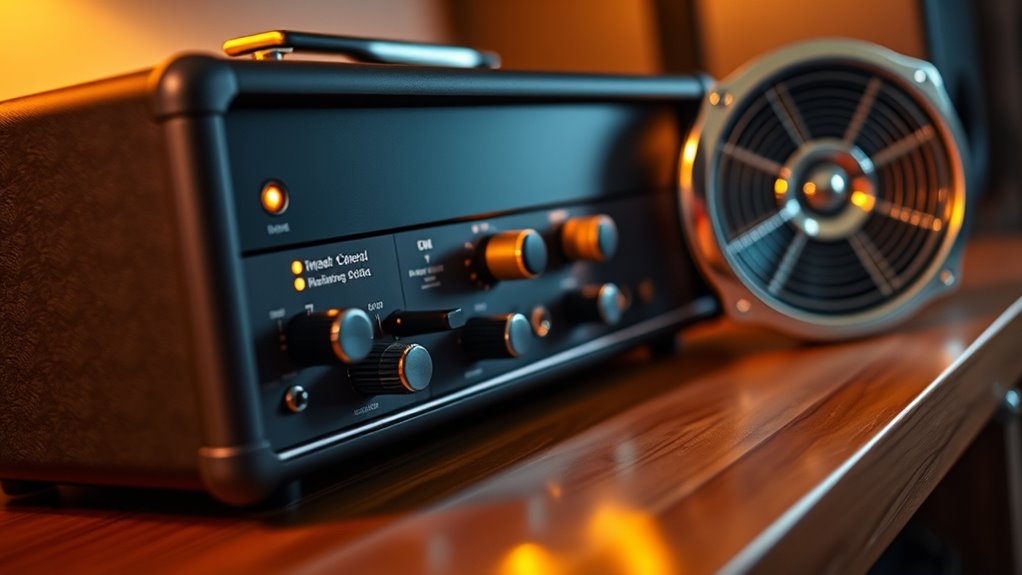

To match your amp and speakers, focus on impedance compatibility and power. Make certain the speaker impedance (like 4Ω or 8Ω) matches your amplifier’s recommended load to avoid distortion or damage. Check that your amplifier’s power output suits your speakers’ handling capacity for clear sound without risking overload. Properly matching these specs ensures your system performs at its best and lasts longer. Keep exploring to discover how fine-tuning these elements can perfect your sound setup.
Key Takeaways
- Match amplifier power output to speaker’s rated power to prevent damage and ensure optimal performance.
- Ensure speaker impedance (Ω) aligns with the amplifier’s compatible load range.
- Use correct wiring (series or parallel) to achieve the desired total impedance load.
- Avoid exceeding the amplifier’s maximum power capacity to prevent distortion or shutdown.
- Proper impedance matching and power levels deliver clear, balanced sound and protect system components.

Choosing the right amplifier for your speakers is essential to achieving the best sound quality. When you’re setting up your audio system, paying attention to speaker placement and crossover frequencies can make a significant difference in how your setup performs. Proper speaker placement ensures that the sound reaches you evenly and clearly, avoiding dead spots or overly harsh areas. Position your speakers at ear level, and keep them a reasonable distance apart to prevent sound waves from overlapping awkwardly. This setup helps your amplifier deliver power more effectively, as it reduces the strain caused by poor placement.
Proper speaker placement at ear level ensures clear, even sound and reduces strain on your amplifier.
Crossover frequencies are equally critical because they determine how the amplifier directs different parts of the audio spectrum to your speakers. If your speakers are part of a multi-way system—say, with separate woofers and tweeters—setting the correct crossover frequency ensures each driver handles the frequencies it’s designed for. This prevents distortion and makes your sound more balanced. When matching amps and speakers, you want an amplifier that can handle the crossover points smoothly, providing clean power without introducing noise or distortion.
Matching your amplifier’s power output to your speakers’ impedance and power handling capabilities is crucial. An amplifier that’s too powerful can push your speakers beyond their limits, risking damage, while an underpowered amp might not deliver enough volume or fullness. To find the right match, check your speakers’ impedance—commonly 8 ohms or 4 ohms—and ensure the amplifier can comfortably deliver the necessary power at that impedance. Many amplifiers specify their power output at different impedances, so comparing these figures helps you choose a compatible pairing.
Additionally, consider how your amplifier manages speaker impedance loads. Some amplifiers are stable across a range of impedances, which gives you more flexibility in speaker placement and configuration. If you’re using multiple speakers, wiring them in series or parallel affects the total impedance load, so you need an amplifier capable of handling that combined load without distortion or shutdown. This compatibility ensures your system runs smoothly and maintains high sound quality.
Ultimately, balancing these factors—speaker placement, crossover frequencies, impedance, and power—gives you the best chance at achieving clear, dynamic sound. When you pay close attention to matching your amplifier and speakers correctly, you set yourself up for a listening experience that’s rich, detailed, and free of unwanted noise or distortion. Properly matching amps and speakers isn’t just about technical specs; it’s about creating a harmonious setup where each component works together seamlessly. Paying attention to the impedance and power handling capabilities of your speakers and amplifier helps ensure optimal performance and longevity of your audio system.
Frequently Asked Questions
Can Mismatched Impedance Damage My Audio Equipment?
Yes, mismatched impedance can damage your audio equipment. When the speaker impedance is too low, your amplifier may overwork, risking overheating and reducing speaker durability. Conversely, if impedance is too high, your amplifier might struggle to deliver enough power, affecting sound quality. Proper matching guarantees amplifier protection, maintaining speaker durability and preventing potential damage. Always check impedance ratings to keep your system running smoothly and safely.
How Do I Measure Speaker Impedance Accurately?
Like a trusty DeLorean, measuring speaker impedance is straightforward if you use the right tools. To get an accurate reading, turn off your amplifier and disconnect the speaker. Then, connect impedance measurement tools, such as a multimeter set to measure resistance, across the speaker terminals. The resistance you see closely matches the speaker’s resistance, but for actual impedance, use an impedance meter or specialized tester for more precise measurements.
Is Higher Wattage Always Better for Speakers?
Higher wattage isn’t always better for speakers. It can help if you want louder sound, but if your amplifier provides excessive wattage, it might cause distortion or damage, especially with low-sensitivity speakers. Pay attention to speaker sensitivity, which indicates how loud they get with a certain wattage. Matching your amp’s power properly ensures clear sound without risking amplifier distortion or speaker damage, giving you ideal audio performance.
Can I Connect Multiple Speakers to One Amp?
You can absolutely connect multiple speakers to one amp, but beware—it’s like juggling flaming torches! You need to consider speaker wiring and impedance matching carefully. If you wire speakers in parallel, total impedance drops and can overload your amp. To avoid damage, add up the impedance values, ensuring it stays within your amp’s safe range. Proper wiring and impedance matching are vital for a safe, powerful setup that sounds amazing.
What Are the Signs of an Underpowered Amplifier?
If your amplifier is underpowered, you’ll notice it struggles to drive your speakers loudly, causing distortion or impedance mismatch. You might hear clipping sounds during high volumes, indicating the amp can’t handle the power demands. Additionally, overheating or excessive heat could be signs. To prevent damage, verify your amp’s power matches your speakers’ impedance and avoid pushing it beyond its limits, which could lead to clipping and reduced sound quality.
Conclusion
So, after all this talk about impedance and power, you might think choosing the perfect amp and speaker is rocket science. But here’s the irony: the best setup often comes down to simply matching what’s on the box. Ignore the technical jargon, trust your ears, and you’ll end up with a sound that’s just right—no fancy formulas needed. Sometimes, the simplest match makes the biggest bang. Happy listening!